Partner marketing strategies focus on investment levels, co-op/MDF, campaigns, and program design. But one critical layer is often overlooked: activation.
Many local marketing strategies lack a deliberate approach to activation and engagement. Without it, local marketing dollars can generate activity without generating meaningful, incremental revenue.
Partner marketing strategies tend to look past activation
Brands already invest heavily in local marketing. The challenge is knowing whether that investment is producing business growth. Too often, success is measured through activity alone:
- How many emails were sent?
- Were the funds claimed?
- How many campaigns were launched and what was the reach?
These metrics matter, but they don’t answer the bigger question: Did the investment drive business growth?
Activation and engagement are the missing connection between partner marketing investment and revenue outcomes. This is where a local marketing activation (LMA) strategy comes into play.
LMA provides the always-on enablement needed to move partners from awareness to action — and from action to measurable business results.
Local marketing activation: from awareness to revenue
At Ansira, our local marketing activation framework follows a simple but powerful progression: awareness, activation, revenue.
Awareness
Make partners aware of the right programs, funds, and resources — at the right time.
- What it does: Surfaces relevant recommendations based on a partner’s engagement history and available marketing funds.
- Business impact: More partners identify relevant opportunities and put available marketing resources to work.
Activation
Guide partners toward the next best action based on behavior, lifecycle stage, and opportunity.
- What it does: Orchestrates targeted prompts, strategies, and reminders that move partners from awareness to execution.
- Business impact: More marketing dollars are put to work through the programs, tactics, and channels most likely to drive results.
Revenue
Close the loop between engagement, utilization, marketing activity, and business results.
- What it does: Measures not only engagement, but what partners executed, how marketing investments were used, and what business results those activities generated.
- Business impact: Brands can connect local marketing investments to measurable business results and optimize based on what works — or shift their strategies based on what’s not working.
The result is a shift from local marketing as a support function to a repeatable driver of revenue growth.
Communication should be a part of your partner marketing strategy, but it needs to be strategic
Communication will always be part of a brand’s partner marketing strategy. The challenge is that most partners are already overwhelmed by the volume and inconsistency of what they receive.
LMA is not about increasing communication for the sake of communication. Instead, it’s about making each interaction more relevant and actionable.
Generic, high-frequency communications create noise and make your programs harder to navigate. Instead, partners should receive specific communications tailored to their needs and journey in your local marketing platform such as:
- Relevant programs and funding opportunities based on their market
- Recommendations generated from their behavior and performance
- Clear, simple next steps and workflows that reduce friction
- Support in the moment, not after the fact
The goal is more partner action that aligns to your revenue strategy. You get there by making every touchpoint specific, contextual, and useful — not by just increasing email volume alone.
3 ways brands can connect local marketing to revenue
Connecting local marketing to revenue demands a clear line of sight from every dollar invested to the business outcomes created. Brands should evolve their approach so local marketing functions as a consistent driver of growth.
1. Look beyond fund utilization
Co-op/MDF utilization is important in partner marketing strategies, but you must measure outcomes to generate the most value. That way, brands can identify where marketing investments are working, prioritize the partners and tactics creating the most value, and put more dollars into market.
Ask: What did those dollars actually do? How can we connect that activity to revenue?
2. Activate partners based on opportunity
Not all partners are the same — and they shouldn’t be treated as if they are.
A new partner, an inactive partner, and a high-performing partner should not receive the same message or call to action. Instead, use identifiers like past behavior and market opportunity to determine what a partner should do next.
This is where Ansira’s LMA services add direct value: it uses partner behavior, lifecycle stage, and opportunity to guide each partner’s next best action.
3. Measure beyond engagement
Metrics like opens and clicks show engagement, but they don’t show impact. To understand ROI, brands need to connect the full journey from communication to revenue.
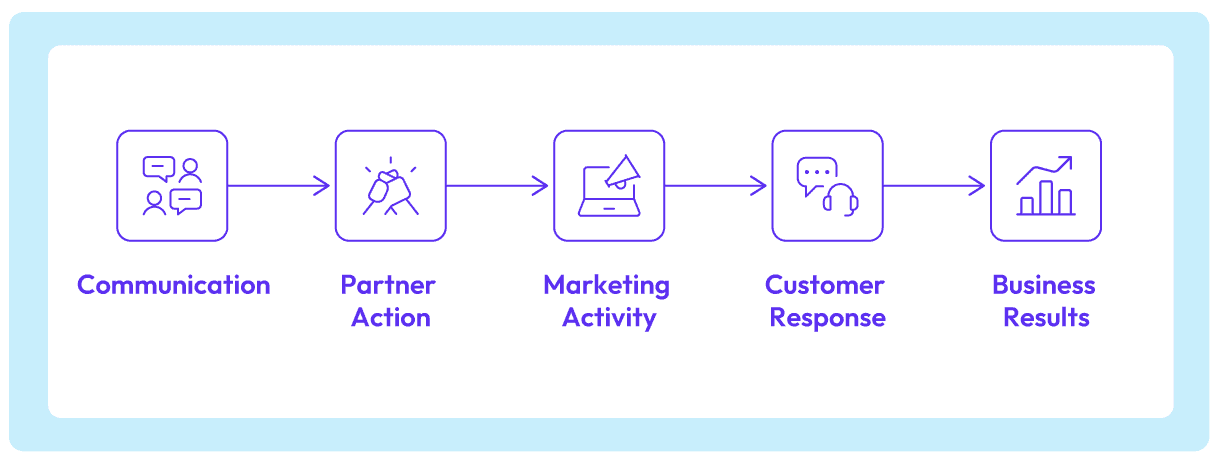
When you track this end-to-end, you can stop guessing which campaigns worked and start investing confidently.
Why an always-on approach is good for your partner marketing strategy
Partner needs, opportunities, and fund levels are constantly changing, and a quarterly update or annual announcement is not enough to keep pace.
An always-on LMA program:
- Keeps programs, funds, and resources top of mind without creating unnecessary noise
- Identifies relevant opportunities and triggers outreach at the right time
- Surfaces next-best actions partners may not identify on their own
- Provides ongoing education and guidance that helps partners take action
Most importantly, it drives a steady cadence of actions — and those actions generate measurable results. This is how local marketing shifts from a support function that helps partners market to an ongoing strategy that helps brands grow.
Turn local marketing activity into measurable growth
Brands don’t necessarily need to communicate more. They need to make local marketing more relevant, actionable, and measurable.
When you connect the right partners to the right opportunities at the right time, local marketing becomes a data-driven revenue engine.
That’s the role of local marketing activation at Ansira: connecting partner engagement to measurable business growth. If you’re interested in meeting with an LMA strategist, connect with our team of experts for an assessment of your brand.