
At Ansira, we hear some version of the same challenge every week.
A brand that’s been growing consistently starts to see softness. The instinct is to look at the strategy. But when you dig in, the strategy is sound. The gap is almost always in how well the brand is enabling its local partners to actually execute it.
We spend most of our time with clients who are navigating exactly this challenge. And across industries the same questions come up:
- How do you empower partners to market effectively without losing brand control?
- How do you reduce the marketing complexity that’s slowing you down?
- How do you turn a channel marketing platform from a cost center into a growth engine?
After years of those conversations, a few answers have become clear.
Most organizations don’t have a technology problem. They have an integration problem.
Redundant point solutions. Homegrown tools that live in one corner of the organization and nowhere else. Enterprise software that doesn’t talk to other platforms.
Each of these compounds into what Ansira likes to call a fragmentation tax: invisible costs paid daily in wasted spend, slower execution, and missed demand.
In a commissioned study conducted by Forrester Consulting on behalf of Ansira, 67% of marketers surveyed said a benefit of an integrated, holistic partner management platform would be increased revenue. In addition, 55% of marketers also said increased efficiency and time savings.
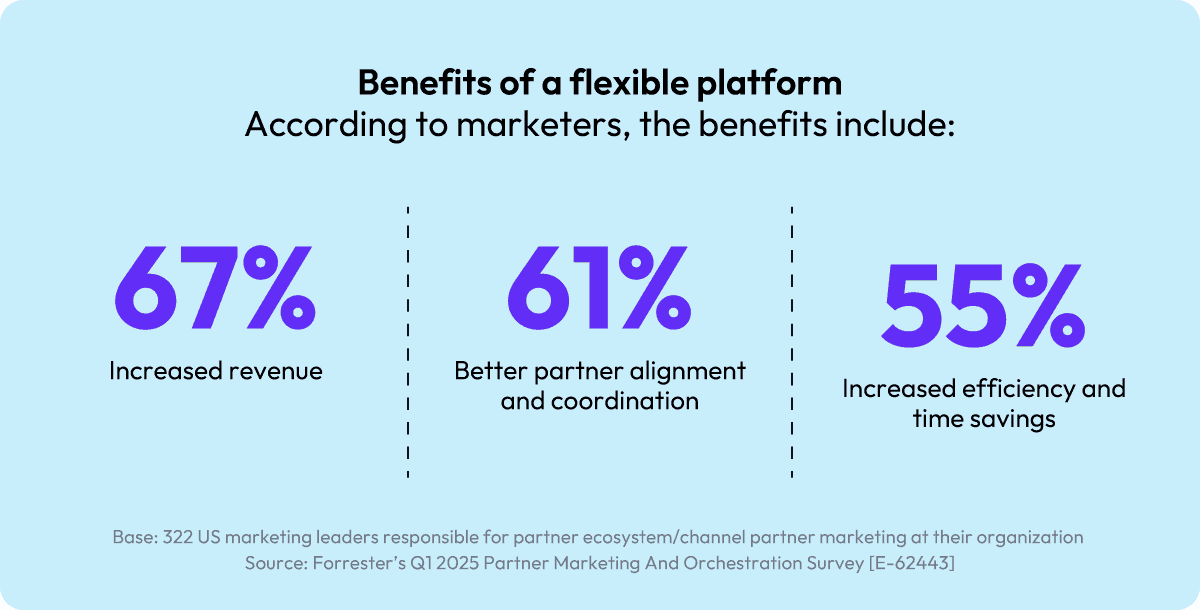
The numbers track with what we see in client offices every week. The fragmentation tax is real — and most organizations are still paying it.
If this problem sounds familiar, peel back your tech layers and start with understanding what your local partners actually experience when they try to use your channel marketing platform.
The best channel marketing platforms make complexity invisible.
The standard is simple: a franchisee or local operator should be able to log in at the end of a long day, do what they need to do, and move on without thinking about the experience at all.
That sounds simple but is extraordinarily difficult to build.
The brands doing this well have invested in making the hard things invisible — data integrations, brand governance, compliance guardrails, co‑op fund management — so that what the end user sees is a clean, intuitive interface that guides them toward action.
They access a single platform that surfaces the right assets, the right campaigns, and the right guidance, all before they have to ask. Self-serve isn’t just great for user experience — it’s great for driving growth.
When local partners can execute independently and confidently, they do it more often. That’s more campaigns in market, more traffic, and more sales for your organization.
Listening is a strategy, not a nice-to-have.

The platforms that keep getting better share one trait: feedback is treated as infrastructure, not as an afterthought.
That means building multiple listening channels but also behavioral data that measure the important questions like:
- Where are users searching?
- Where do they drop off?
- When does a task end with a call to customer service instead of a completed campaign?
User behavior tells you things users won’t say.
It also means extending the feedback loop beyond the platform itself. Field sales teams, regional leaders, account managers — these are our ears on the ground. When the same friction point surfaces across multiple regions, that’s a signal.
The organizations that build systems to catch those signals early are the ones that stay ahead of user needs instead of reacting to them.
End users should be the loudest voice in your listening strategy.
There are no shortcuts in integration.
One of the most common misconceptions we run into: deploying a channel marketing platform is a project with a finish line.
It isn’t. It’s ongoing. One client describes it as the plumbing and wiring that has to be extended as the business evolves.
The brands that have built effective brand‑to‑local ecosystems have done so by solving integration problems systematically over time:
- Connecting the platform to CRM data so content can be personalized at scale
- Giving local partners real-time visibility into co-op funds and program performance
- Creating compliant pathways for third-party vendors and local media
Each of those integrations, individually, might seem small. Collectively, they’re what separates a platform people actively use from one they work around.
Start with the integrations that remove the most friction for your highest-volume users. Instrument everything and build for where the business is heading — not just where it is today.
Performance visibility closes the loop.
A channel marketing platform without measurement is just a content library. The full value comes when you can see what’s working, where it’s working, and for whom — at every level of the organization.
That means local partners seeing their own campaign results. Regional leaders tracking adoption across their markets. Central teams using that data to make smarter investment decisions — and identifying what’s working in one market so it can scale to others.

When measurement is embedded into the platform experience, it stops being a reporting function and instead becomes the feedback loop that continuously improves performance.
The brands building now will be hard to catch in two years.
The programs pulling ahead aren’t optimizing for this quarter. They’re building for where the industry is heading.
That means including AI-assisted content creation into the local marketing workflow so local partners can produce on-brand, personalized materials without waiting on a home office team.
It means giving local partners audience-specific playbooks and campaign blueprints, not just a blank canvas.
And it means investing in the data integrations that make personalization possible at scale, because generic content won’t move the needle in a competitive local market.
The technology is not going to wait. The brands investing in this infrastructure now are building a structural advantage. The ones waiting are already behind.
The question we always come back to: what does your local partner experience look like right now when they try to market their business? And what would it look like if it were genuinely easy?
The gap between those two answers is the opportunity.
How Ansira thinks about this in practice
At Ansira, we see organizations grappling with challenges like fragmentation across tools, disconnected data, inconsistent local execution, and limited visibility into performance every day — and that is what the Ansira platform is built to solve.
At its core, Ansira helps enterprise brands unify their channel marketing ecosystem into a single, flexible platform that connects national strategy to local execution.
That means bringing together the core capabilities brands need to operate at scale — content and asset management, campaign and program execution, incentive and co-op fund management, and performance measurement — into one connected environment instead of a collection of disconnected tools.
Because everything is connected, performance doesn’t sit in silos. Brands can see what’s working in real time, understand adoption and engagement at the local level, and scale successful campaigns across regions much more quickly.
That’s the value Ansira delivers: it turns a fragmented channel marketing environment into a connected system where strategy, execution, and measurement all work together, making it easier for brands to scale growth through every local partner.