
Turning brand intent into local impact
A co-op program is more than a funding mechanism. It is one of the brand’s most practical tools for turning national strategy into local action.
The brand owns the identity, but the local partner owns the relationship, the market context, and often the moment of purchase. A well-designed funding program helps bridge that gap. It gives brands a way to invest where decisions actually happen, while helping local partners market with more confidence, consistency, and relevance.
At its best, a cooperative model does three things at once:
- Extends the brand into local markets with greater authenticity
- Gives partners a reason to align with approved messaging and priorities
- Creates shared accountability for results
Because both sides are invested, the program becomes more than a reimbursement. It becomes a strategic lever to influence how the brand shows up in market, what products get promoted, and where future dollars should go.
This is the real value of a funding program. It helps brands protect consistency without over-controlling the local experience, accelerate the right business priorities without funding everything equally, and capture the market-level insight needed to make smarter decisions over time.
The value of a well-designed funding program shows up in measurable business outcomes as well. According to Ansira Aggregate Data, every 1% increase in co-op utilization equates to 7% more leads. When brands make it easier for partners to invest in local marketing, both engagement and performance improve.
A little skin in the game goes a long way. When local partners are invested too, campaigns are more likely to be executed with care, measured more closely, and treated less like bonus dollars and more like the real business-building spend they are.
Matching the funding program model to the business need
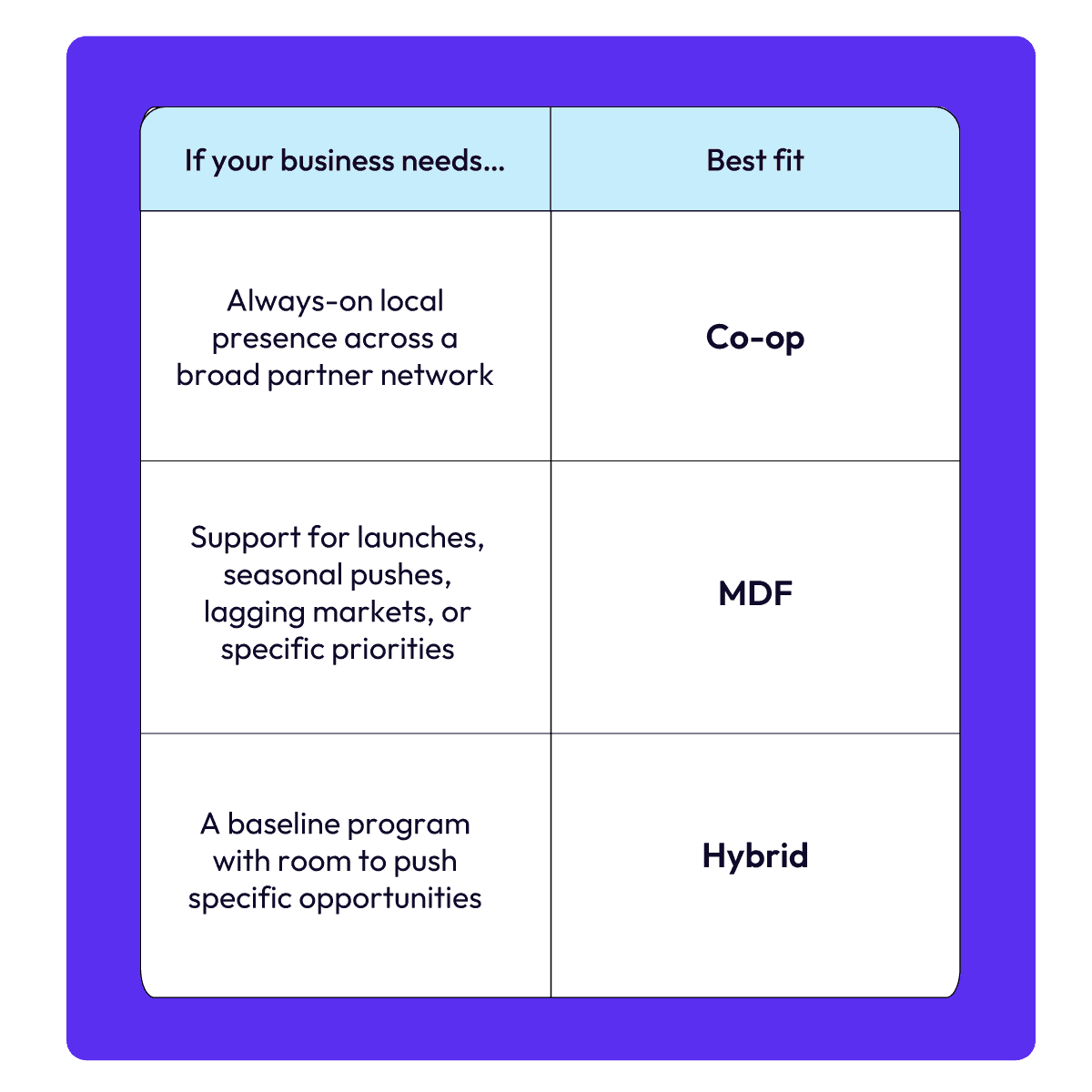
Different funding models solve different business needs. Co-op is best for consistency, MDF is best for agility, and a hybrid model is often the smartest choice when a brand needs both steady local support and targeted strategic investment.
Co-op: The engine for consistency
Co-op is the foundational model for brands that want continuous, always-on local activation across a broad partner network. Because funds accrue over time, usually in relation to sales or purchases, partners have a more predictable budget to plan against and a clearer incentive to stay engaged with the brand.

Strategically, co-op is designed to reinforce loyalty and retention while supporting efficient local growth. Since the funding is performance-linked, it naturally aligns partner marketing activity with the brand’s actual product penetration. In other words, the partners driving the most business are also the ones earning the most opportunity to reinvest in local demand.
The result is a more consistent brand presence, stronger relationships with established partners, and a stable base of local activity that supports long-term market health.
Marketing development funds: The Engine for agility
Marketing development funds (MDF) are the model brands use when they need more control, flexibility, and speed. Instead of accruing automatically, funds are allocated intentionally based on brand priorities or partner opportunities. That makes MDF especially useful for launches, seasonal pushes, market expansion, lagging territories, or other moments where sales history alone should not determine where money goes.

Strategically, MDF helps brands with direct investment toward the opportunities that matter most right now. It can be used to accelerate growth in underperforming markets, support new product introductions, encourage adoption of new channels, or back specific initiatives a partner might not prioritize on their own.
The result is greater agility in changing market conditions, better support for strategic business moments, and more freedom to test, learn, and optimize at the local level.
Hybrid: The brand-to-local balance
As programs mature, many adopt a hybrid approach, allowing them to tailor program design over time to better align with evolving business objectives and dealer needs. Co-op serves as the foundation, giving the full network a baseline level of support to maintain brand presence and standard operations. MDF-style elements then act as strategic overlay, introducing tools like marketing plans, fund requests, and pre-approval processes that help the brand direct additional dollars into the market with greater intention.
Rather than simply adding more funding, this approach creates a more strategic framework for how incremental investment is requested, evaluated, and aligned to business priorities.
This structure works well because it balances fairness with control. It prevents smaller but loyal partners from being left behind, while still giving the brand the flexibility to invest more aggressively in priority markets, high-potential partners, or time-sensitive initiatives.
The result is a funding model that supports broad participation without sacrificing precision.
And this is really just the start. As programs evolve, brands can borrow the smartest elements from each model to put dollars in market more strategically, keep messaging aligned, and still leave room for the local flavor that makes the whole thing work.
Where good funding programs go sideways
The automotive industry is a good example that shows partner funding only creates value when the program is both strategically designed and easy to use. Automotive dealers widely value co-op funding, creating an opportunity for original equipment manufacturers (OEMs) to drive both participation and strategic business outcomes, while leading OEMs use varying program design levers to balance dealer engagement, brand standards, compliance, and performance outcomes.
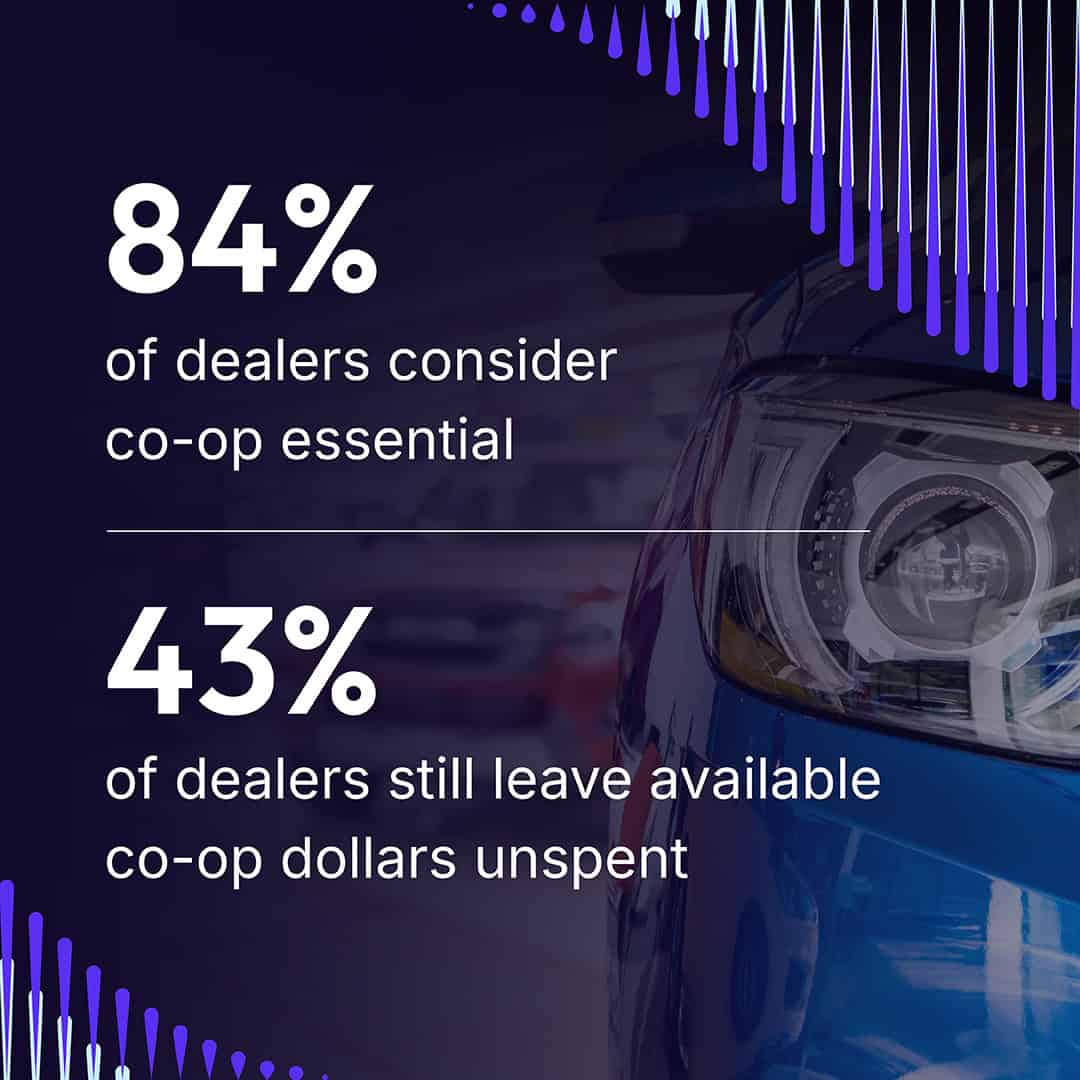
84% of dealers consider co-op funding important or essential to their marketing efforts. However, participation alone does not guarantee program effectiveness.
On the other hand, 43% of dealers report leaving available co-op funds unused, citing:
- Program complexity
- Administrative burden
- Restrictive requirements
- Unclear return on investment
The biggest risk with funding programs is not only lack of participation. It is designing a program that is too loose to guide behavior, too cumbersome to use, or too opaque to improve. The strongest programs are structured enough to direct investment, simple enough to drive utilization, and visible enough to optimize over time.
Common pitfalls in funding program design
1. Treating funds like a rebate instead of an investment
When co-op or MDF is treated as money to hand out rather than capital to direct, brands may get activity but not necessarily strategy. Stronger programs connect dollars to business priorities through fund requests, tactic rules, pre-approvals, and partner qualification logic.
Ansira Incent supports that approach by allowing brands to set rules, choose tactics, and determine which partners qualify for funding.
2. Making the process harder than it needs to be
Even a smart program can underperform if it feels like homework. When claims, approvals, and reimbursement are too manual or time-consuming, partners are more likely to disengage or leave funds unused.
Ansira Incent helps reduce that friction through streamlined claims, automation, and simpler workflows that make funds easier to access and activate.
3. Measuring spend without measuring impact
If a program only tracks whether funds were used, it misses whether those dollars actually moved the business. Strategic programs need visibility into where partners are spending, which tactics are being used, and what results those investments are generating.
Ansira Incent supports that visibility through performance monitoring and real-time reporting, helping brands make smarter decisions about what to scale, refine, or stop.
One size never fits brand-to-local funding programs
The strongest funding programs are not built once and left alone. They evolve with the business, the market, and the behaviors a brand is trying to drive at the local level.
Whether you are refining a mature program or building a new one, the goal is the same: Create a model that is strategically clear, operationally simple, and flexible enough to support changing priorities over time.
A few questions can help shape the right approach:
- What business outcomes matter most right now?
- What funding rhythm best fits the way your business plans, sells, and resets budgets: annual, quarterly, or campaign-based?
- Which local tactics actually drive measurable outcomes, and which should be deprioritized?
- How should reimbursement rates, pre-approvals, vendors, and proof requirements steer partners toward the right behaviors?
- What guidelines, playbooks, templates, and training will make compliant execution easier?
- What dashboards, surveys, and KPI reviews will help keep the program aligned as needs change?
There is no single perfect funding model — only the model that best fits the business need, partner network, and outcomes the brand is trying to create. That is where thoughtful funding program design matters most.
Elevate your funding programs with Ansira
To learn more about co-op and MDF program design and how Ansira Incent can help brands structure, manage, and execute these funds through a marketing platform built for brand-to-local growth, contact Ansira today.
Ansira Incent can help brands structure, manage, and execute a successful funding program. To learn more about co-op and MDF program design built for brand-to-local growth, book a quick walkthrough of Ansira’s unified platform.