AI-powered search is changing the way consumers discover, assess, and commit to brands. With 2.5 billion messages processed daily by ChatGPT alone, this drastic shift in user behavior is impacting everything from organic traffic to click-through rates to session times. As a result, it’s crucial for brands to prepare their teams and local partners to navigate media execution wisely to maintain brand visibility in AI search.
Ansira recently hosted The Channel Effect 2026, where guest speaker Nikhil Lai, Principal Analyst at Forrester, alongside Mick Gier, Senior Director, Organic Media at Ansira, and Catie Cryder, EVP, Media at Ansira, shared their research and perspectives on the topic of answer engine optimization in the session Evolving Media in the Age of AI.
Dive into the insights and gain the tools you need to make AI-powered search your competitive advantage.
The impact of AI search on the revenue cycle
Answer engines have made a major impression on top-of-funnel dynamics over the last year. In fact, what used to be a race for the most clicks is slowly transforming into a battle for visibility and authority.
To better understand how this shift is impacting marketing and revenue performance, here are three major ways AI search is reshaping the revenue cycle.
1. Organic traffic is declining while AI traffic increases
According to Forrester research interviews, organic traffic has declined by 10%–40% in 2025 due to the effects of AI search. As this direct traffic erodes, more and more users are moving to large language models (LLMs) like ChatGPT and Perplexity, with answer engine referrals growing by about 40% month over month.
2. Bot traffic is rising significantly
In addition to a shift in traffic distribution, AI search has also brought about a spike in bot traffic — also known as dark traffic or gray traffic. This is when bots from various answer engines visit websites to train their models on product information and answer user queries. Bot traffic is particularly difficult to detect and may account for a significant portion of a brand’s site traffic — sometimes in the tens of thousands.
3. Branded traffic is growing
Lastly, branded traffic — or searches that include the name of a brand or its product — is on the rise. When a consumer encounters a brand through AI search, they‘re more likely to seek it out again later in their buying journey. That means fewer competitors, greater impulse buying intent, and a higher likelihood of conversion when retargeted by your brand. Historically, only channels like TV, out-of-home, audio, and radio have driven this kind of branded demand.
How is the shift from SEO to AEO affecting search behavior?
With the rise of AI-powered search comes an evolution in web users’ search behaviors.
Before AI, the average search query was between three and four words. Now, searchers are using natural language in their queries rather than conducting simple searches, with queries reaching an average of 23 words. And while answer engine click-through rates average only 1-5%, time per session has reached a staggering 23 minutes per session, with users asking up to eight related questions.
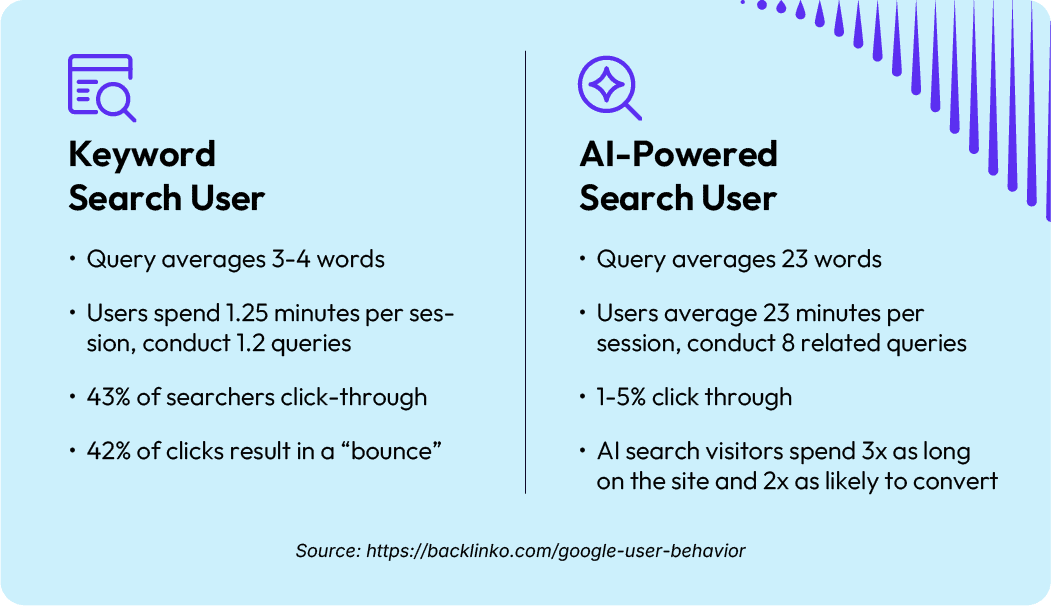
So, while AI searchers aren’t clicking on web pages as often, they spend three times longer on the sites they do choose to visit — and are twice as likely to convert on those pages.
It’s clear that answer engines are bringing much higher-quality traffic to brand’s sites compared to search engines. However, in order to benefit from these pattern shifts, your brand needs to be visible in AI search.
How to improve brand visibility in AI search engines
So, how exactly do you make your brand appear in AI search results? Forrester research suggests there are four major changes brands should make to their media strategies to see improvements in visibility:
- Publish multimodal content: Utilize a range of content types, such as imagery, video, infographics, and glossaries. Each piece of content should be optimized for natural language queries and answer an FAQ.
- Don’t prioritize for Google Bot: Most AI bots can’t render pages heavy with JavaScript, so websites designed for Google Bot likely won’t be visible on other answer engines.
- Measure branded search: Branded search is the strongest leading indicator of market share growth, underscoring the importance of monitoring your share of voice on answer engines.
- Polish your reputation: Every answer engine (with the exception of Google) prioritizes what others say about a brand over what brands say about themselves. Focus on reputation management and PR to gain third-party content that speaks highly of your brand.
Many of these recommendations represent a fundamental shift in how brands approach online visibility, placing greater emphasis on reputation and third-party validation. Now is the time to reevaluate how your brand appears across the web and what others are saying about it — because in AI-driven search, that external perspective matters more than ever.
Categories that influence AI-powered search in local marketing
On the local level, AI-powered search looks a little different than it does on a national scale. While visibility is still the name of the game, your partners have a shorter list of things to target — though they’ll be competing much harder for these spots.
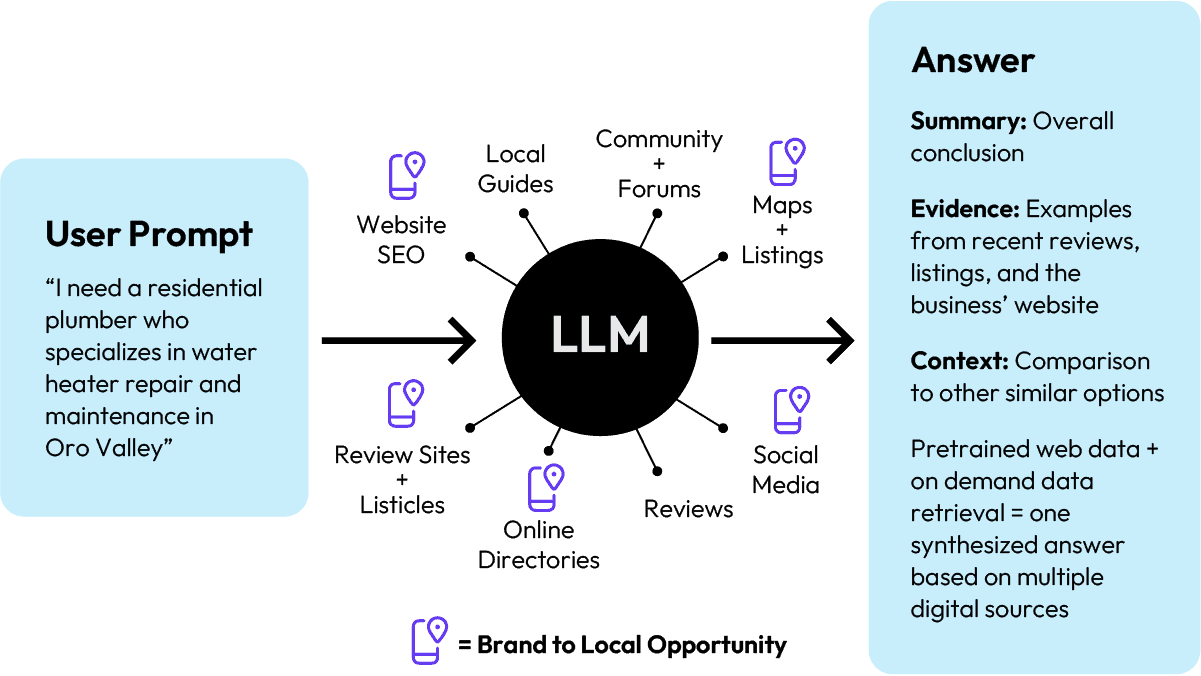
When a searcher enters a query into an LLM, that answer engine will assess your holistic digital footprint, meaning it will look everywhere your brand or local partner is referenced. This footprint includes:
- Website SEO
- Local guides
- Maps and listings
- Community forums
- Social media
- Online directories
- Reviews
- Review sites and listicles
Ways to improve AI visibility for local partners
Here are a couple of things to keep in mind when preparing your partners to tackle discoverability in AI search engines:
- Ensure cross-platform reach: While Google remains dominant, consumers (chiefly Gen Z) are increasingly turning to Instagram, TikTok, and ChatGPT for local recommendations, emphasizing the need for partners to distribute content across other touchpoints.
- Manage social listings: When it comes to local results, third-party content like Reddit threads, Yelp reviews, and social media reviews are more prevalent on answer engines than they are on Google. That’s why partners must manage their social listing data and work with PR to ensure that authoritative sources are discussing your brand.
- Hyper-localize content: Google’s algorithm now rewards content marketed at the tribal or cultural level.
Answer engine optimization best practices
With a clearer understanding of how AI-powered search works and how it impacts your brand on the local level, the next step is to reevaluate your strategy for ranking within answer engines.
Consider implementing the following answer engine optimization best practices into your strategy to achieve greater visibility in AI search results:
- Shift from keyword usage to natural language
- Invest in reputation management and PR to boost third-party content
- Focus on non-branded language rather than brand-specific content
- Audit your partners to understand how AI-ready they are
- Focus on increasing content velocity by using AI to boost output
Not sure where your brand and local partners currently stand in terms of AI readiness? You can better reflect on your position by asking yourself the following questions:
- If we asked an AI assistant about our brand in our top markets, what would it say — and based on what content?
- Do our national, regional, and/or local teams share a single view of audiences, content, and funding, or three different ones?
Answering these questions will help you identify where your brand should refocus to improve visibility in AI search.
Where AI engines are now vs. where they’re going
Currently, we’re in the articulate stage of AI, where answer engines are enabling consumers to have conversations using large datasets. However, users are becoming more comfortable with the assistive stage of the journey, where AI agents take action on the searcher’s behalf.
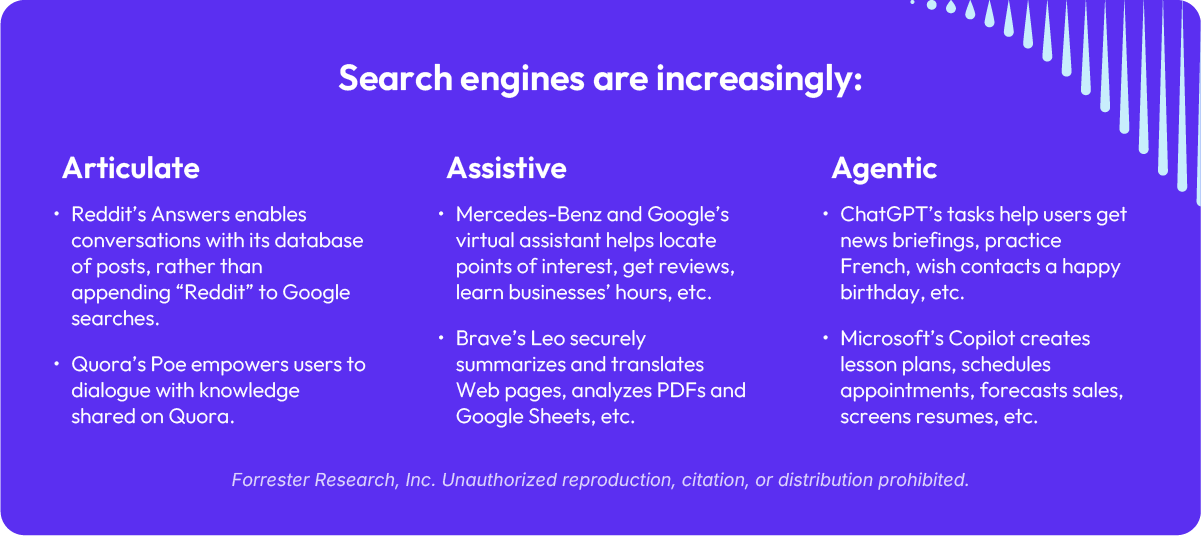
Soon, we’ll see a greater increase in AI-powered transactions. Due to the convenience of AI search, these transactional conversations will likely take place directly on answer engines rather than through merchant websites.
Additionally, we can expect to see more ads appearing on AI-powered search engines, which will be bought on cost per thousand impressions (CPM) instead of cost per click (CPC) given the zero-click experience.
Improve visibility in AI search with Ansira
AI is transforming how brands and their partner networks are discovered — but with the right approach, you can turn answer engines into a powerful growth channel, maximizing high-quality traffic and conversions.
Master answer engine optimization across your brand and local partners with AEO services from Ansira. With the power of our performance-backed, brand-to-local platform and the human expertise of 1,300+ team members, Ansira unifies technology, data, and services to streamline workflows and drive marketing performance at scale.
Want more data-driven insights on AI in media? Watch the full session here.