
When Prohibition ended in 1933, the United States faced a critical question: How do you regulate an industry that had just spent 13 years operating in the shadows? The answer was the three-tier system — a regulatory framework that separates suppliers, distributors, and retailers to prevent the tied-house abuses and market manipulation that plagued the pre-Prohibition era.
Nearly a century later, this system remains the bedrock of alcohol distribution in America. It’s unquestionably legitimate from a legal standpoint, upheld by courts and embedded in state law across the country. Yet it’s also increasingly debated. Craft producers question whether the system creates unnecessary barriers to market entry. Direct-to-consumer advocates push for more flexibility in an ecommerce-driven world. Large retail chains navigate a patchwork of 50+ different state regulatory frameworks, each with its own nuances and exceptions.
The tension is real, but so is the opportunity. This guide will explain how the three-tier system works, where it flexes by state, and — most importantly — how each tier can use data, technology, and strategic partnerships to thrive within it, not just tolerate it.
What is the three-tier system?
The three-tier system is straightforward in concept but complex in execution. At its core, it mandates that alcoholic beverages flow through three distinct, legally separated tiers before reaching consumers.
The structure works like this:
- Tier 1: Suppliers, producers, and importers: Breweries, wineries, distilleries, and importers manufacture alcoholic beverages and sell only to licensed distributors and wholesalers.
- Tier 2: Distributors and wholesalers: These state-licensed intermediaries purchase products from suppliers, manage logistics and warehousing, ensure regulatory compliance, and sell to retailers.
- Tier 3: Retailers (on- and off-premise): Bars, restaurants, liquor stores, grocers, and convenience outlets sell directly to consumers. Retailers are divided into on-premise establishments and off-premise outlets.
Product flows in one direction — from producer to consumer — while money flows in the opposite direction. No single entity can typically own or control more than one tier, a restriction designed to prevent the vertical integration that characterized the pre-Prohibition era.
Key objectives of the system include:
- Preventing vertical monopolies and tied houses (where producers owned retail outlets and coerced them into exclusively selling their brands)
- Supporting public health goals by creating accountability at each tier for age verification, product safety, and responsible marketing practices
- Simplifying tax collection by concentrating oversight at the distributor level, where excise taxes are collected and products are tracked through the supply chain
- Creating a transparent chain of custody that helps regulators quickly identify and remove tainted or counterfeit products from the market
Typical state-level rules reflect these objectives. Producers generally cannot sell directly to retailers, retailers cannot buy directly from producers, and cross-ownership across tiers is restricted. However, exact rules vary significantly by state, creating a regulatory landscape that can feel more like 50 different systems than one unified framework.
Roles, responsibilities, and revenue across the three tiers
Understanding what happens at each tier is essential for anyone working within the alcohol three-tier system.
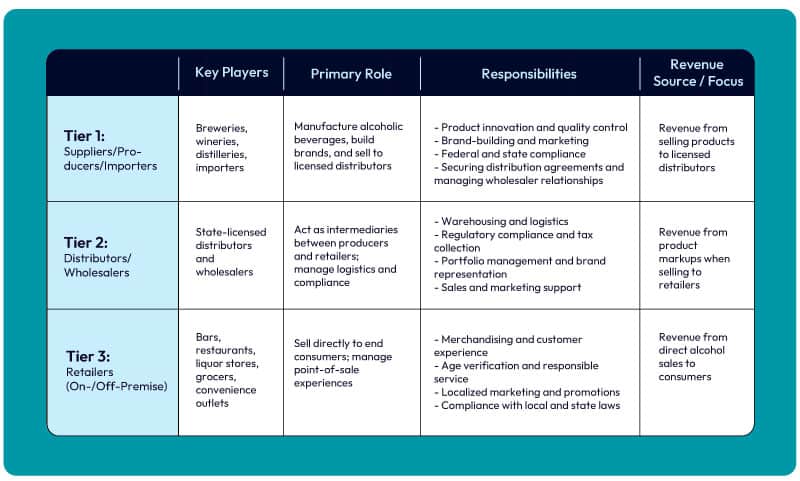
Tier 1 – Suppliers/producers/importers
Breweries, wineries, distilleries, and importers make up the first tier. These entities are responsible for manufacturing alcoholic beverages, building brands, and selling to licensed distributors under both state and federal regulations.
Producers must secure federal permits from the Alcohol and Tobacco Tax and Trade Bureau (TTB) as well as state-specific licenses. Their primary challenge is gaining distributor attention and shelf space in an increasingly crowded marketplace, particularly for smaller craft producers competing against established national brands.
Key responsibilities include:
- Product innovation and quality control
- Brand-building and marketing
- Navigating complex compliance requirements at both the federal and state levels
- Securing distribution agreements and managing relationships with wholesalers
Tier 2 – Distributors/wholesalers
Distributors are the linchpin of the system, acting as the bridge between producers and retailers. State-licensed intermediaries purchase products from producers, manage logistics and warehousing, ensure regulatory compliance, and sell to retailers.
Distributors often operate with exclusive territories and manage diverse portfolios of brands, making them powerful gatekeepers in the system. They’re responsible for collecting excise taxes, tracking products through the supply chain, and ensuring that all products meet state and federal standards before reaching retail shelves.
Distributors’ key responsibilities include:
- Warehousing and logistics
- Regulatory compliance and tax collection
- Portfolio management and brand representation
- Sales and marketing support for both suppliers and retailers
For many producers, securing a strong distributor relationship is the single most important factor in market success.
Tier 3 – Retailers (on-premise and off-premise)
The final tier includes bars, restaurants, liquor stores, grocers, and convenience outlets that interface directly with consumers. Retailers are divided into on-premise establishments (where alcohol is consumed on-site) and off-premise outlets (where alcohol is purchased for consumption elsewhere). They handle local merchandising, promotions, and age verification and responsible service. Retailers must navigate local regulations that can vary not only by state but also by municipality, including rules around operating hours, proximity to schools or churches, and permissible marketing activities.
Key responsibilities of retailers include:
- Merchandising and customer experience
- Age verification and responsible service
- Localized marketing and promotions
- Compliance with local and state regulations
Why the three-tier system was created (and why it endures)
The three-tier distribution system emerged from a specific historical moment, but its persistence reflects ongoing regulatory and commercial benefits.
Historical context
Before Prohibition, the alcohol industry was characterized by tied-house practices where producers owned retail outlets and used aggressive sales tactics to maximize consumption. When the 18th Amendment was repealed in 1933 through the 21st Amendment, states were given authority to regulate alcohol as they saw fit. Post-Prohibition concerns about uncontrolled consumption, abusive tied-house practices, and lost tax revenue drove states to adopt the three-tier distribution system as a safeguard against returning to pre-Prohibition conditions.
Regulatory and public health benefits
The system supports age verification by requiring retailers to check IDs at the point of sale. It enables product traceability — when contaminated or counterfeit products are discovered, the three-tier system allows for rapid recalls by tracking products through each tier. It also facilitates enforcement of responsible marketing and sales practices, which regulators and control boards still cite as key advantages nearly 90 years after the system’s creation.
Economic and commercial benefits
By separating tiers and licensing many distributors and retailers, the structure can level the playing field and give small producers access to markets they could not reach alone. The system generates tens of billions of dollars in tax revenue for federal, state, and local governments. It also reduces the risk of untaxed “black market” alcohol reaching consumers by requiring licensed entities at each tier to maintain accountability for products moving through the supply chain.
State-by-state nuance: control states, exceptions, and DTC
While the three-tier system provides a common framework, implementation varies dramatically across states.
Control vs. license states
Some states act as distributors or retailers themselves — these are known as control states. In control states, part or all of the distribution tier, and sometimes the retailing tier, is operated by the state government rather than by independent private entities. States like Utah and Pennsylvania monopolize both distribution and retail tiers, while states like Michigan maintain monopolies over distribution only.
License states, by contrast, permit private entities to operate as distributors and retailers, applying the three-tier system through permits and regulation rather than direct state operation.
Implications for stakeholders:
- In control states, producers and distributors may have less flexibility but benefit from a more predictable regulatory environment.
- In license states, competition among private distributors and retailers can create more opportunities for innovation and market entry, but also more complexity.
Common exceptions
The system includes numerous carve-outs that blur traditional tier boundaries. Brewpubs can simultaneously produce and retail beer without selling to a distributor. Many states permit wineries to sell bottles directly to customers on-site. Some states allow small craft producers limited self-distribution rights, letting them act as their own distributor within certain volume thresholds. Tasting room models have proliferated, allowing producers to sell directly to consumers in controlled environments while still working with distributors for broader retail distribution.
Emerging pressure points
Ecommerce and marketplace delivery platforms are creating new challenges for the three-tier distribution system. While some states have expanded direct-to-consumer (DTC) shipping — particularly for wine — these exceptions often come with complex compliance requirements around age verification, shipping permits, and volume limits.
Delivery apps and online marketplaces must navigate how they fit within the three-tier framework, typically partnering with licensed retailers rather than selling directly to consumers. Washington State represents the most significant exception to the traditional model, having eliminated the legal requirement for a three-tier distribution system in 2011, though in practice the system largely persists through exclusive marketing agreements between producers and distributors.
Benefits of the three-tier system for each stakeholder
Despite ongoing debates, the three-tier system delivers tangible benefits across the alcohol supply chain.
For regulators and governments
The system makes tax collection easier by concentrating oversight at the distributor level, where excise taxes are collected as products move through the supply chain. It provides clearer enforcement mechanisms by creating licensed checkpoints at each tier. It also offers better visibility into inventory and sales across the supply chain, enabling regulators to track products from manufacturing to retail and quickly identify problems like contaminated batches or counterfeit products.
For producers (especially craft)
The three-tier system provides access to retail networks that would be prohibitively expensive for individual producers to build themselves. Distributors help navigate compliance requirements that vary by state and municipality, reducing the regulatory burden on producers.
The system also enables brand expansion across multiple states through distributor relationships, allowing even small craft producers to achieve national distribution if they secure the right partnerships.
For retailers and consumers
Retailers benefit from product variety — distributors aggregate products from multiple producers, giving retailers access to diverse portfolios without managing dozens of individual supplier relationships. The system creates competitive pricing dynamics by preventing vertical integration that could lead to price-fixing. Consumers gain assurance that products are sourced, transported, and stored under regulated conditions, reducing the risk of tainted or counterfeit alcohol reaching the market.
While craft producers sometimes criticize the system for favoring large distributors and established brands, some industry groups argue it has actually enabled robust craft growth by preventing dominance by a few vertically integrated giants and ensuring that small producers can access distribution networks.
Criticisms, challenges, and the craft debate
No regulatory system is without its critics, and the three-tier system faces ongoing scrutiny.
Common criticisms
The system can favor large distributors and established brands, making it difficult for small producers to secure distributor attention and shelf space. It creates barriers for small producers who may lack the resources to navigate complex state-by-state regulations and build distributor relationships. Critics also argue that it can slow innovation or market entry by adding layers of complexity and cost between producers and consumers.
Craft producer perspective
Craft producers express particular concerns around franchise laws that make it difficult to change distributors once a relationship is established. They cite limited flexibility in building direct relationships with consumers and retailers, particularly as consumer preferences shift toward local and artisanal products. Many craft producers argue that the system was designed for a different era and hasn’t adequately adapted to the realities of modern craft beverage production and distribution.
Legal landscape
The Supreme Court has affirmed that a properly structured three-tier system is legitimate under the 21st Amendment. However, ongoing state-level debates continue over self-distribution rights, direct-to-consumer shipping, and exceptions for small producers. The legal landscape remains dynamic, with states regularly adjusting regulations to balance traditional three-tier principles with evolving market realities.
Strategic implications: how to win inside the three-tier system
Rather than fighting the system, successful brands are learning to leverage it strategically.
For suppliers
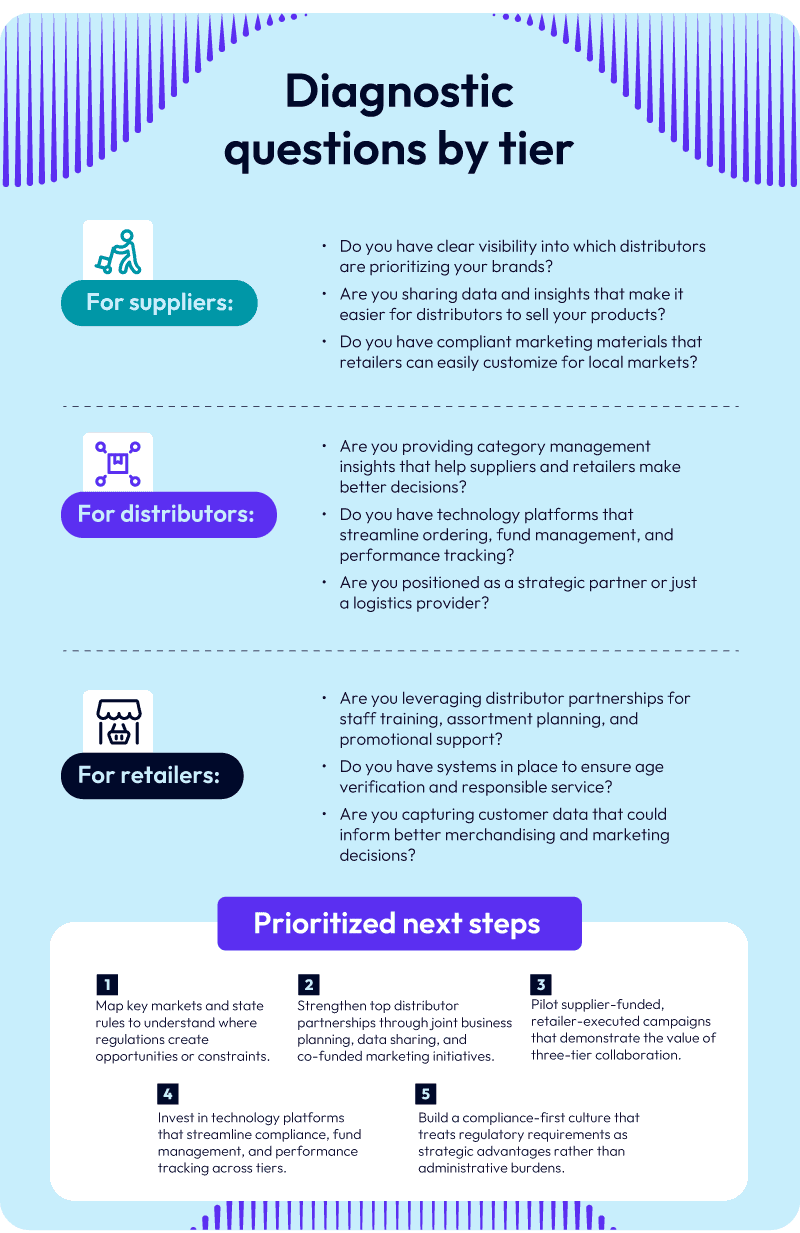
Build strategic distributor relationships through joint planning, data sharing, and co-funded marketing to secure priority in portfolios and shelving. The most successful supplier-distributor partnerships go beyond transactional relationships to create true strategic alignment around market opportunities and consumer insights.
Invest in demand creation through supplier-funded media, retail activation, and consumer pull that make it easier for distributors and retailers to justify support. When suppliers create consumer demand through advertising, social media, and brand-building activities, they make it easier for distributors to sell and retailers to stock their products.
For distributors
Use data and marketing services to become indispensable partners to suppliers and retailers, not just logistics providers. Distributors who can provide point-of-sale data, consumer insights, and category management expertise create value beyond simply moving products from warehouse to shelf.
Leverage category management, localized programming, and omnichannel capabilities to drive incremental sales and capture a larger share of supplier marketing budgets. The most sophisticated distributors are evolving from pure logistics players into marketing services providers who help suppliers and retailers optimize assortment, pricing, and promotions.
For retailers
Partner with distributors for assortment planning, staff education, and compliant promotions that differentiate the store experience and increase basket size. Retailers who work collaboratively with distributors can access training, point-of-sale materials, and promotional support that would be difficult to secure independently.
Technology, data, and the future of the three-tier system
Digital transformation is reshaping how the alcohol three-tier system operates, even as its fundamental structure remains intact.
Digital acceleration and ecommerce
Online ordering, delivery apps, and retail marketplaces are operating within the alcohol three-tier system while changing expectations for inventory, pricing, and promotions. Most delivery platforms partner with licensed retailers rather than selling directly, maintaining the three-tier structure while offering new convenience to consumers. These platforms are creating new data streams and consumer insights that can be shared across tiers to optimize the entire supply chain.
Data and analytics across tiers
Point-of-sale data, loyalty insights, and campaign performance metrics can be shared within legal constraints to optimize assortment, pricing, and co-op marketing. Suppliers who can access retailer POS data through distributor partnerships gain visibility into what’s selling, where, and to whom — insights that inform everything from product development to marketing strategy. Distributors who aggregate and analyze this data across their portfolios can provide category management insights that help both suppliers and retailers make better decisions.
Automation and partner platforms
Marketing technology, partner management tools, and distributed marketing platforms are streamlining supplier-distributor-retailer collaboration while keeping compliance intact. These platforms enable suppliers to create brand-compliant marketing materials that distributors and retailers can customize for local markets, ensuring consistency while allowing for local relevance. They also automate fund management, claim processing, and performance tracking, reducing administrative burden and increasing transparency across the three tiers.
Responsibility, compliance, and brand reputation
In an industry as heavily regulated as alcohol, compliance isn’t just a legal requirement — it’s a strategic asset.
Public health and responsibility
The three-tier system supports age-gating by requiring retailers to verify customer age at the point of sale. It enables responsible marketing guidelines by creating accountability at each tier for how products are promoted and sold. It also provides product traceability that allows for rapid recalls when safety issues arise.
Brands must treat these as strategic requirements, not just legal checkboxes — consumers increasingly expect brands to demonstrate social responsibility, and the three-tier system provides a framework for doing so.
Compliance as a brand asset
Rigorous compliance across tiers protects brands from regulatory action that can result in fines, license suspensions, or market access restrictions. It preserves retailer and distributor trust — partners are more likely to support brands that make compliance easy rather than risky. It also supports long-term brand equity by ensuring that every consumer touchpoint reflects brand values and meets legal standards.
Embedding responsibility into campaigns
Successful brands incorporate responsible messaging into their marketing, from “drink responsibly” taglines to moderation initiatives that demonstrate commitment to public health. They invest in staff training for retailers and distributors to ensure that everyone selling their products understands responsible service practices. They also align campaigns with three-tier regulations by working within the system rather than trying to circumvent it, building trust with regulators and partners alike.
Action plan: how to audit your position in the three-tier system
Ready to optimize your strategy within the three-tier framework? Here’s what you need to do:
How Ansira can help
Navigating the three-tier system requires more than an understanding of regulations — it demands technology, data, and expertise to orchestrate compliant, omnichannel marketing programs across all three tiers. Ansira specializes in helping beverage alcohol brands synchronize their distribution ecosystems, from compliance management and digital asset management to co-op fund administration and localized campaign execution.
Whether you’re a supplier looking to strengthen distributor relationships, a distributor seeking to provide more value to partners, or a retailer aiming to optimize your alcohol category, Ansira’s platform and services can help you thrive within the three-tier system.
Ready to master the three-tier system?
The three-tier system isn’t going away — but that doesn’t mean you can’t innovate within it. By understanding how the system works, where it flexes, and how to leverage data and partnerships strategically, you can turn regulatory complexity into a competitive advantage.
Book a demo to discover how Ansira can help you orchestrate brand-to-local growth across the three-tier system.