
Manufacturers today face relentless pressure to grow market share, protect margins, and keep distributors and retailers engaged in an increasingly competitive landscape. In this high-stakes environment, one of the most consequential decisions a manufacturer can make is how to structure channel incentives. At the heart of this decision lies a fundamental question: rebate vs. discount — which approach delivers better outcomes for your manufacturing channel?
The answer, as you might expect, is not one-size-fits-all. Both rebates and discounts serve important roles in a manufacturer’s commercial toolkit, but they work in fundamentally different ways and produce very different results. Understanding when to use each tactic — and how to combine them strategically — can mean the difference between sustainable, profitable growth and a race to the bottom.
In this guide, we’ll explore the definitions of rebates and discounts in a manufacturing context, examine their behavioral and financial impacts, clarify how manufacturing rebates differ from consumer rebates, and show you where software rebate solutions fit into a modern incentive strategy.
Rebate vs. discount
Before we can evaluate which approach works best, we need to establish clear definitions for each term in the context of B2B manufacturing channels.
What is a discount?
A discount is an upfront reduction in price applied at the time of sale. In manufacturing channels, this typically appears as a percentage off the list price on an invoice or through promotional pricing. For example, a distributor might receive a 10% discount on a bulk order, reducing the invoice price from $100,000 to $90,000 immediately.
Discounts are simple, visible, and immediate. They show up on every invoice and directly influence the customer’s purchasing decision at the moment of order. Common types include volume discounts for large orders, promotional discounts for limited-time campaigns, and discretionary discounts that sales teams apply within approved corridors.
What is a rebate?
A rebate is a retrospective incentive where a portion of the purchase price is returned to the buyer after specific conditions are met, often over a defined period. Unlike discounts, rebates are paid out after the fact — typically quarterly or annually — and only when agreed-upon targets are achieved.
In manufacturing channels, rebates are typically structured around performance metrics such as volume thresholds, year-over-year growth, product mix targets, or marketing support commitments. For instance, a distributor might earn a 4% rebate on all purchases if they hit 10,000 units in a year, or a 10% rebate if they reach 25,000 units.
Key differences: timing, certainty, and behavior
The rebate vs. discount decision comes down to three fundamental differences:
- Timing: Discounts reduce price immediately at the point of sale, while rebates return money later, after performance conditions are verified.
- Certainty: All discounts are paid on every qualifying transaction, whereas rebates are only paid when targets are met — creating what’s known as “breakage” when partners fall short.
- Behavior: Discounts influence a single transaction, while rebates shape ongoing behavior across an entire period, encouraging partners to plan, commit, and stretch toward targets.
Why manufacturers often default to discounts (and the hidden costs)
Discounts are popular in manufacturing channels for good reason. They’re simple to communicate, easy to execute, and deliver a fast impact on price-sensitive deals. When a distributor is comparing your product to a competitor’s, a visible discount can tip the scales in your favor immediately.
But this simplicity comes with hidden costs that can erode profitability over time.
Margin erosion that’s hard to reverse
Once you grant a discount, it becomes the new baseline price in the customer’s mind. Trying to raise prices later, even back to the original list, feels like a price increase rather than a return to normal. This phenomenon, known as price anchoring, makes it extremely difficult to recover margins once discounts become standard practice.
Limited control over sell-through
When you discount to a distributor, you have little control over whether that discount gets passed along to the end customer or simply pads the distributor’s margin. This creates unpredictable pricing in the market and can undermine your brand positioning.
Minimal data capture
Discounts rarely require registration, claim processes, or detailed reporting. While this makes them administratively simple, it also means you’re missing valuable insights into customer behavior, partner performance, and market trends that could inform future strategy.
Unrealistic pricing expectations
When discounts become routine, partners and buyers begin to expect perpetual promotions. This creates a cycle where normal list prices feel inflated, and customers delay purchases waiting for the next sale. Over time, this erodes pricing power and makes it harder to maintain healthy margins.
What are manufacturing rebates?
Manufacturing rebates are structured, performance-based incentives that reward channel partners (distributors, dealers, and retailers) for achieving specific targets over a defined period. Unlike simple discounts, these programs tie financial rewards directly to measurable outcomes that align with the manufacturer’s strategic goals.
How manufacturing rebates work
A typical manufacturing rebate program follows this structure:
- Agreement on targets and tiers: The manufacturer and partner agree on specific performance metrics, such as volume thresholds, revenue targets, or product mix goals. These are often structured in tiers. The higher the performance, the greater the rebate percentage.
- Tracking performance over time: Throughout the contract period (typically quarterly or annually), the manufacturer tracks the partner’s purchases against the agreed targets using sales data, EDI systems, or rebate management software.
- Rebate calculation and payment: Once the period ends and conditions are verified, the manufacturer calculates the rebate amount and issues payment. This is typically a check, credit note, or direct deposit.
Common types of manufacturing rebates
Manufacturing rebates come in several varieties, each designed to drive specific behaviors:
- Volume-based rebates reward partners for purchasing specific quantities, with higher percentages kicking in at higher volume tiers.
- Growth-based rebates incentivize year-over-year increases, encouraging partners to expand their commitment to your product line.
- Product mix rebates encourage partners to maintain balanced purchasing across your portfolio, preventing over-concentration in a single product family.
- Market development rebates (similar to MDF) reward partners for marketing activities that drive demand, such as trade show participation or co-branded campaigns.
- Stepped or tiered rebates create breakpoints that motivate partners to stretch for the next tier, often resulting in incremental volume that wouldn’t occur with flat-rate incentives.
Consumer rebates vs. channel rebates
While both fall under the rebate umbrella, consumer rebates and manufacturing rebates serve very different purposes and operate in distinct ways.
Consumer rebates: direct to end users
Consumer rebates are incentives paid directly to end customers after a qualifying purchase. These typically take the form of cash-back offers, prepaid cards, or digital credits that consumers claim by submitting proof of purchase.
The primary goals of consumer rebates are to drive demand at the shelf or online, capture first-party data from end users, and create a sense of value without permanently lowering retail prices. They’re common in categories like appliances, electronics, and vehicles, where high-ticket purchases benefit from post-purchase incentives.
Manufacturing rebates: motivating the channel
Manufacturing channel rebates, by contrast, primarily motivate distributors, dealers, and resellers to stock, promote, and sell more of the manufacturer’s products. Rather than influencing the end consumer directly, these programs shape partner behavior across the entire sales cycle.
The key difference is strategic focus. Consumer rebates are about pulling demand through the channel by making the end product more attractive. Manufacturing rebates are about pushing product through the channel by making it more profitable and strategically aligned for partners to carry and promote your line.
When to use each
Manufacturers should deploy consumer rebates when they need to drive retail-facing promotions, compete on shelf price without permanent discounts, or capture end-user data for future marketing. These work especially well for high-consideration purchases where consumers are actively comparing options.
Manufacturing rebates are the better choice for long-term channel growth, increasing share of wallet with key distributors, and creating strategic alignment with partners around volume, mix, or market development goals.
How rebates and discounts shape partner behavior
The rebate vs. discount decision isn’t just about accounting. It’s fundamentally about human psychology and how different incentive structures influence decision-making.
How discounts influence behavior
Discounts create immediate gratification. They reduce the pain of payment at the moment of purchase, making the transaction feel like a win. This can be powerful for closing deals quickly and responding to competitive pressure.
However, discounts also encourage short-term, price-focused thinking. When partners know they can negotiate a discount on every deal, they’re trained to focus on price rather than value. This can create a race-to-the-bottom dynamic where margins erode across the entire channel.
Discounts also fail to create forward-looking commitment. Once the discounted transaction is complete, there’s no ongoing incentive to maintain or grow the relationship. Partners may switch to a competitor offering a better discount on the next deal.
How rebates influence behavior
Rebates, by contrast, create goal-oriented behavior. When a distributor knows they’ll earn a 10% rebate if they hit 25,000 units — but only 4% if they stop at 10,000 — they’re motivated to plan ahead, commit inventory, and push for that higher tier.
This creates what behavioral economists call “breakpoint effects.” Partners will often add extra volume at the end of a period specifically to qualify for the next rebate tier, generating incremental sales that wouldn’t occur with flat discounts.
Rebates also encourage loyalty and long-term planning. Because rebates are paid retrospectively and often structured across quarters or years, partners have an incentive to maintain consistent purchasing patterns rather than shopping around for one-off deals.
One often-overlooked aspect of rebates is breakage. This is the portion of rebates that go unclaimed or unearned because partners don’t meet the conditions. While this might sound negative, breakage actually makes rebates financially attractive for manufacturers while still motivating behavior.
Partners who fall just short of a tier still increased their purchasing in pursuit of the rebate, even if they didn’t ultimately earn it. This creates a win-win: the manufacturer gets incremental volume without paying the full incentive, and the partner is motivated to try harder next period.
Financial impact: margins, cash flow, and revenue recognition
Beyond behavior, rebates vs. discounts have significant implications for your financial statements and cash management.
Margin impact
Discounts reduce revenue and margin on every qualifying transaction immediately. If you offer a 10% discount on a $100,000 order, you’re booking $90,000 in revenue from day one. This hits your margin instantly and permanently for that transaction.
Rebates, by contrast, allow you to book higher revenue upfront while only paying incentives on achieved performance, often at period end. Using the same example, you’d book the full $100,000 in revenue initially, then accrue a liability for the potential rebate. If the partner doesn’t hit their targets, you keep the full margin.
Cash flow and forecasting
Discounts simplify invoicing but can depress cash inflows and pricing power. You’re collecting less money upfront, which impacts working capital and can create cash flow challenges, especially for manufacturers with long production cycles.
Rebates create liabilities that need accurate accruals and can complicate finance if not managed well. However, they allow you to collect full payment upfront and smooth incentive payments over time, aligning them with fiscal periods and improving cash flow predictability.
Revenue recognition and compliance
Rebates add complexity to revenue recognition. Under accounting standards, you must estimate and accrue for expected rebate payments, which requires accurate data and forecasting. This can create audit challenges if your systems aren’t robust.
However, modern software rebate solutions have largely solved this problem by automating accrual calculations, integrating with ERP systems, and providing audit trails that satisfy compliance requirements.
Where rebates outperform discounts in manufacturing channels
While both tools have their place, manufacturing rebates typically deliver superior outcomes in several key scenarios.
Complex channel ecosystems
In manufacturing channels with multiple tiers of partners, like OEMs, distributors, dealers, and retailers, rebates provide the precision and control that discounts can’t match. You can structure different rebate programs for different partner types, each aligned with their specific role in the value chain.
Strategic initiatives
When you’re trying to gain share with specific distributors, drive mix toward higher-margin SKUs, or enter new regions, rebates give you the targeting precision to reward exactly the behaviors you want without collapsing list price across the entire market.
Long sales cycles
In industries with long sales cycles and complex buying processes, rebates create sustained engagement over time. Partners stay focused on your products throughout the cycle because they’re working toward a cumulative target, not just optimizing individual transactions.
Data-driven insights
Because rebate claims flow through structured processes, especially when managed through software rebate platforms, they generate rich data on partner performance, product mix, regional trends, and program effectiveness. This intelligence is invaluable for refining future strategy.
When discounts still make sense
Despite the advantages of rebates, discounts remain the better choice in certain situations.
Simple, transactional deals
For one-off transactions with no ongoing relationship or volume commitment, the administrative overhead of a rebate program isn’t justified. A straightforward discount gets the deal done quickly and efficiently.
Short-term inventory clearance
When you need to move excess inventory fast, perhaps due to a product refresh or seasonal shift, discounts can create immediate price perception changes that drive rapid sell-through. Rebates, which have delayed payouts, don’t create the same urgency.
Transparent shelf pricing
In retail environments where shelf price matters and consumers are comparing options, manufacturers sometimes need visible price reductions that discounts provide. A rebate paid to the retailer might not translate to a lower shelf price, undermining the promotional impact.
Smaller partners or geographies
In markets where you haven’t yet built rebate infrastructure or are working with smaller partners who lack sophisticated systems, discounts may be the only practical option until you can scale your rebate capabilities.
The role of software rebate management
One of the biggest historical barriers to manufacturing rebates has been operational complexity. Tracking agreements, calculating payouts, managing accruals, and handling disputes across dozens or hundreds of partners was a nightmare of spreadsheets and manual processes.
Software rebate solutions have changed this equation entirely.
What rebate management software does
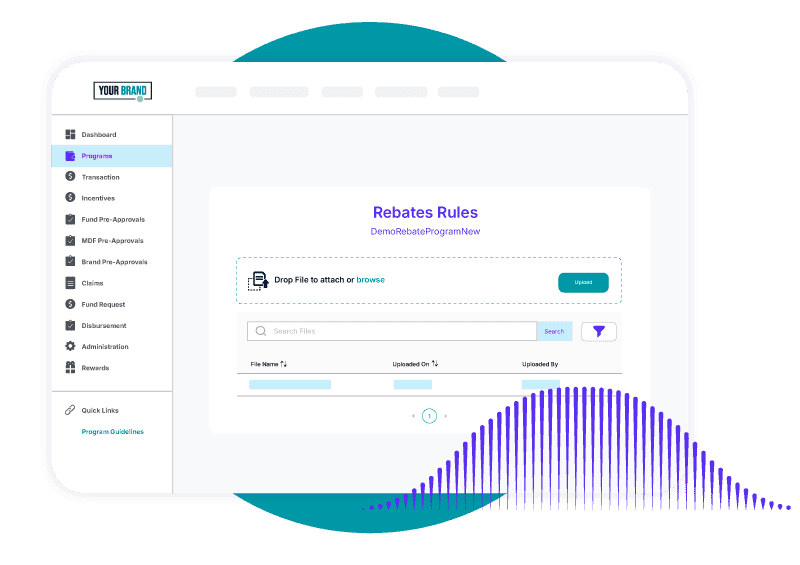
Modern rebate management platforms centralize agreements, automate calculations, and handle accruals and payouts with minimal manual intervention. They integrate with enterprise resource planning (ERP) and customer relationship management (CRM) systems to pull accurate purchase data, apply complex rules and tiers, and generate reports on partner performance and program profitability.
Key capabilities include:
- Automated calculations that eliminate spreadsheet errors and ensure partners are paid accurately and on time.
- Real-time tracking that gives both manufacturers and partners visibility into progress toward targets, encouraging stretch behavior.
- Accrual management that automatically calculates liabilities for financial reporting and ensures compliance with accounting standards.
- Analytics and insights that show which programs are driving ROI, which partners are performing, and where opportunities exist for optimization.
How software changes the rebate vs. discount equation
Historically, many manufacturers defaulted to discounts simply because rebates were too hard to manage. Rebate platforms remove this friction, making it feasible to run sophisticated, personalized rebate programs at scale.
This technology enables you to:
- Segment partners by tier, region, or product family and offer tailored rebate structures to each group.
- Adjust programs mid-period based on market conditions or performance trends without creating chaos.
- Combine multiple rebate types, like volume, growth, and mix, into a single cohesive program that drives multiple strategic objectives simultaneously.
In short, software rebate solutions make rebates as operationally simple as discounts while preserving all their strategic advantages.
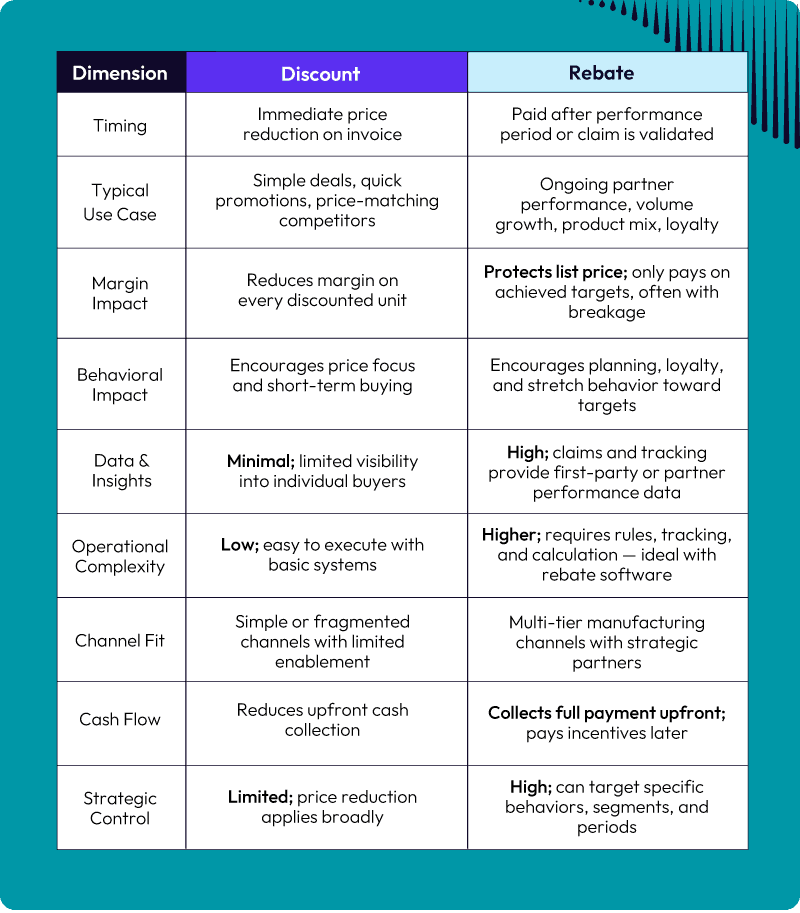
Rebate vs. discount: a direct comparison
To bring the rebate vs. discount decision into sharp focus, here’s a side-by-side comparison across key dimensions:
Designing manufacturing rebates that actually work
Understanding the theory behind rebates is one thing; designing programs that deliver results is another. Here are best practices for moving beyond basic structures and creating rebates that truly drive partner behavior.
1. Start with clear objectives
Before designing any rebate program, define what you’re trying to achieve. Are you focused on volume growth, market share gains, product mix improvement, or partner retention? Each objective requires a different rebate structure.
Segment your partners accordingly. High-volume distributors might respond to growth rebates, while smaller regional dealers might need volume thresholds that feel achievable.
2. Keep structures simple
Even when powered by sophisticated rebate software, your rebate structures need to be simple enough for partners to understand and track. If a distributor can’t easily calculate whether they’re on track for a rebate, the program loses its motivational power.
Avoid overly complex terms with multiple conditions and exceptions. The best rebate programs have clear, transparent rules that partners can internalize and plan around.
3. Avoid common pitfalls
Be aware of common rebate challenges:
- Poor data quality is the enemy of effective rebates. If your purchase tracking is inaccurate or delayed, partners will dispute payouts and lose trust in the program. Invest in data integration and validation upfront.
- Manual spreadsheets create errors, delays, and disputes. If you’re managing rebates in Excel, you’re setting yourself up for problems. Modern software rebate solutions eliminate these risks.
- Overly aggressive targets that partners can’t realistically achieve will demotivate rather than inspire. Set stretch goals, but make sure they’re attainable with effort.
Combine rebates with MDF-style incentives
Consider layering manufacturing rebates with market development funds or co-op programs that support marketing activities. This creates a comprehensive incentive structure that rewards both sell-in (volume rebates) and sell-through (marketing support).
Blended strategies: using rebates and discounts together
The most sophisticated manufacturers don’t choose between rebates and discounts — they use both strategically.
Layered incentive structures
A common approach is to use modest discounts for transparent shelf pricing and immediate competitiveness, while layering manufacturing rebates to reward strategic behaviors and long-term loyalty without eroding headline price.
For example, you might offer a 5% standard discount to all distributors to keep your products price-competitive, then add a tiered volume rebate that rewards top performers with an additional 5-10% based on annual volume. This protects your competitive position while creating upside for partners who commit.
Measuring better outcomes: KPIs to track
To determine whether rebates or discounts are delivering better outcomes, you need to define what “better” means and track the right metrics.
Defining success
Better outcomes should mean more than just top-line revenue. The goal is profitable growth and healthy partner relationships that sustain over time. This requires looking at margin realization, partner retention, and strategic alignment, not just sales volume.
KPIs for discounts
When evaluating discount programs, track:
- Promotional lift: How much incremental volume did the discount generate compared to baseline?
- Cannibalization rate: Did the discount simply shift purchases forward in time, or did it create truly new demand?
- Net margin: After accounting for the discount, what margin did you actually realize?
- Price realization: What percentage of the list price are you actually collecting across all transactions?
- Post-promo volume: Do sales return to baseline after the discount ends, or do they drop below baseline as partners wait for the next promotion?
KPIs for manufacturing rebates
For rebate programs, focus on:
- Incremental volume vs baseline: How much additional volume did the rebate program generate compared to what partners would have purchased anyway?
- Partner retention: Are partners renewing their commitments and staying loyal to your product line?
- Mix improvements: Are rebates successfully shifting partner purchases toward higher-margin or strategic products?
- Payout vs. accrual accuracy: How well are you forecasting rebate liabilities, and are you avoiding disputes?
- Program ROI: What’s the return on every dollar spent on rebates in terms of incremental profit?
Modern rebate management solutions and analytics tools make it possible to track these KPIs in near real time, giving you the visibility to optimize programs on the fly rather than waiting for quarterly reviews.
Fuel channel performance with Ansira
Real competitive advantage comes from orchestrating manufacturing rebates, consumer rebates, and discounts together in a cohesive, software-driven incentive strategy that aligns every stakeholder, from factory floor to end customer, around profitable growth.
If you’re ready to rethink your rebate strategy and build incentive programs that actually move the needle, Ansira is here to help.
Get in touch with an Ansira expert to explore how modern manufacturing rebates, consumer rebates, and smart discounting can work together to support your growth goals.