In our recent Ansira webinar, “SEO & AEO for Channel Marketers: How to Win in AI-Powered Search,” we heard a clear message from clients and prospects: AI-powered search isn’t a futuristic concept anymore. It’s already reshaping how customers discover brands, locations, and solutions.
If you lead marketing for a distributed brand, whether that’s agents, dealers, franchisees, or branches, your challenge is bigger than “staying visible.” You have to protect your brand narrative, empower local partners, and make sense of increasingly fragmented data, all while AI engines rewrite the rules of search.
This article recaps the key takeaways from the session and connects them to deeper dives from our team, including Measuring Success in AI Search and Brand Reputation Management and AI.
Traditional search vs. AI search: What’s really changing?
Traditional search isn’t going away — but AI search is changing where and how customers make decisions.
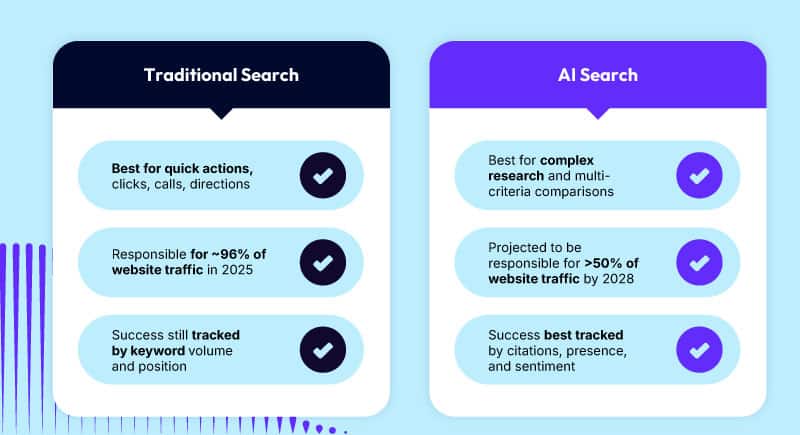
In traditional search, success is still largely tracked by keyword rankings and organic traffic. It’s great for quick actions: clicking through to a website, calling a location, or getting driving directions. Today, those experiences still drive the vast majority of website visits — roughly 96% of traffic in 2025, according to Semrush research we highlighted in the webinar.
In AI search, the model itself becomes the interface. Customers ask complex, multi-step questions and get synthesized answers instead of a list of links. Success is better measured by citations, overall presence, and brand sentiment — not just where you rank for a specific keyword.
Semrush’s AI search studies point to three critical shifts we discussed:
- Some projections show AI search will drive more than 50% of website traffic by 2028.
- AI-driven visitors are 4.4x more valuable than traditional searchers because they’ve already done the research before they ever hit your site.
- That means fewer, more qualified visits, and greater pressure on brands to show up well in AI-generated answers.
For channel marketers, the implication is straightforward: You can’t afford to treat AI search as a side project. It needs to be built into how you think about SEO, content, and local enablement — not layered on top as an experiment.
For a deeper look at how to measure the right KPIs in this new landscape, explore our team’s article, Measuring Success in AI Search.
How does AI change the customer journey?
In the webinar, we contrasted two journeys:
- The traditional journey: A user searches on Google, opens multiple articles and review sites, clicks back and forth, and eventually lands on one or more brand sites to compare options.
- The AI journey: A user asks an AI engine, “What’s the best [product] for my situation?” The AI summarizes options, compares pros and cons, factors in user sentiment, and then the user asks follow-up questions before shortlisting a few brands to explore further.
Instead of competing for every click along the way, you’re now competing to be in the answer — and for the AI to describe you accurately and favorably.
That’s why we emphasize Answer Engine Optimization (AEO) as an evolution of SEO, not a replacement. Many of the same fundamentals still matter, but there are specific tactics that are more important than ever:
- Structure and clarity (schema, clean architecture) help AI understand and trust your content.
- Reputation and reviews help it decide how to talk about you.
- Your holistic digital footprint — websites, listings, reviews, and social content —all feed into the story AI tells about your brand.
Centralized vs. decentralized networks
For distributed brands, strategy isn’t just about SEO or AEO in isolation. It’s about how you align brand and local execution across a complex network of “rooftops.”
In the webinar, we talked through challenges in both models:
Centralized ecosystems
Centralized strategies can bring consistency, but in an AI-first world, they also introduce real hurdles:
- Localization: How do you reflect local needs and nuances within a unified strategy at scale?
- Agility: With technology and AI evolving so quickly, centralized programs risk becoming stagnant.
- Performance gaps: It’s hard to elevate underperforming locations while still pushing high performers to the next level.
- Analytics at scale: When you have 50, 100, or 500+ locations, consolidating KPIs and extracting actionable insight is non-trivial.
Decentralized ecosystems
On the other end of the spectrum, decentralized networks face a different problem: too much variability.
- Every rooftop has unique goals, budgets, and team structures.
- Individual efforts can become combative or cannibalistic, competing for the same audiences and keywords.
- SEO/AEO requires consistent, strategic change over time, which is difficult without influence or governance.
- Measuring progress across a patchwork of local efforts is complicated at best.
Our point in the webinar was simple: Whether you skew centralized or decentralized, you need a brand-to-local operating model that works in an AI-first world. That’s where clear division of labor, shared platforms, and thoughtful governance come in.
AEO best practices for distributed brands
We focused on three practical recommendations that channel marketers can act on now.
1. Your web platform matters more than ever
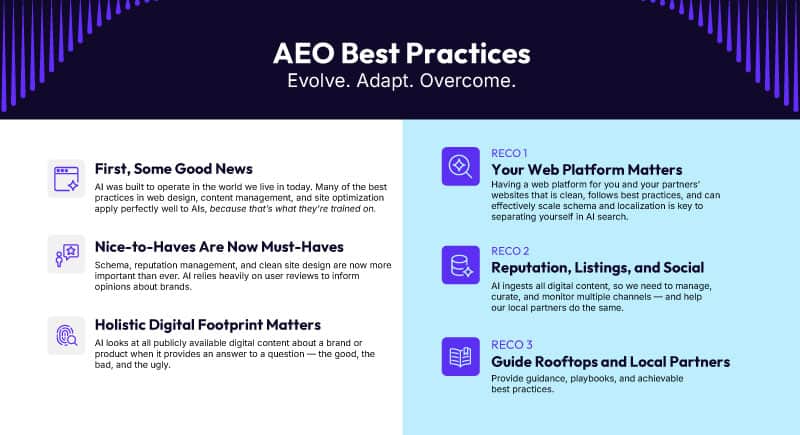
AI was trained on the web we already built — which means best practices in web design, content management, and site optimization still apply.
Across both brand and local sites, prioritize:
- Clean, modern technical foundations: fast load times, mobile-first layouts, and logical site structures.
- Scalable schema and localization: a platform that can roll out structured data and localized content across hundreds of locations without custom manual work.
- Consistent brand hierarchy: so that AI engines can clearly connect local entities back to the parent brand.
A healthy web platform isn’t just good UX — it’s how you become legible to AI.
2. Treat reputation, listings, and social as must-haves, not nice-to-haves
AI doesn’t just read your website. It ingests reviews, listings, and social content to understand what real customers think of you.
That’s why:
- Reviews are no longer a “reputation project”; they are part of your core search strategy.
- Local listings must be accurate, complete, and aligned with brand positioning.
- Organic social helps shape your brand image and expertise in ways that AI engines can observe and summarize.
We dig into this in more detail in our article, How User Reviews and Social Media Shape Your Brand’s Image in AI Search.
3. Guide rooftops and local partners with real guardrails
Owning your holistic digital footprint across hundreds or thousands of local partners is not about centralizing everything — it’s about clarity and enablement.
We recommend brands consider the following:
- Define what is non-localizable (brand voice, core messaging, compliance requirements).
- Provide playbooks and achievable best practices for local teams, aligned to their reality and resources.
- Use platforms like Ansira’s to distribute brand-approved content, enable localization within guardrails, and automate compliance.
- Establish network-wide analytics that can plug into your ecosystem and give you a clear read on visibility, sentiment, and AI prompt response across locations.
The optimal brand-to-local model, as we showed in our social content governance example, is a clear division of labor: brand sets the guardrails, retailers localize within them, and technology operationalizes it at scale.
How to get started with AI and your brand
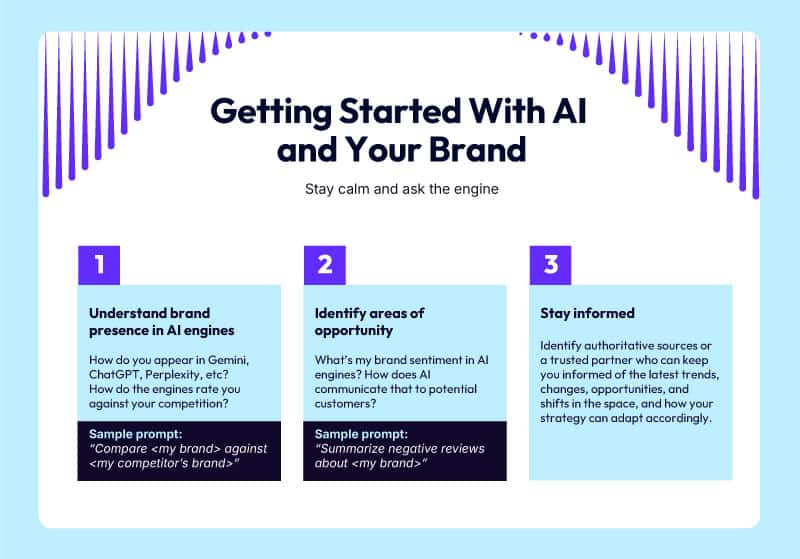
If you’re unsure where you stand today, you don’t need a custom tool to get started. In the webinar, we suggested a few simple, practical prompts you can use in major AI engines:
- “Summarize negative reviews about <brand> .”
- How does the AI describe your weaknesses?
- Are those issues isolated or systemic across locations?
- “Compare against <my competitor’s brand>.”
- Which benefits does it highlight for you vs. your competitors?
- What sources is it citing? Are those sources accurate and current?
- “How do customers talk about <brand> in reviews and social media?”
- Does the sentiment align with how you want to show up in the market?
- Are there patterns you can address via content, service, or enablement?
From there, your next steps should focus on:
- Understanding your AI presence across Gemini, ChatGPT, Perplexity, and other engines.
- Prioritizing fixes that improve both traditional SEO and AI-readiness (technical health, content clarity, and reputation).
- Staying informed through authoritative sources and partners who can help you adapt as the space evolves.
What’s next in AI search?
We closed the webinar by looking at what’s on the horizon:
- In-engine purchases: Major platforms are beginning to enable transactions directly inside AI agents.
- AI-driven ads and sponsored results: Paid placements in AI search experiences are coming quickly.
- Accelerating adoption: While AI search usage is still only a fraction of traditional search today, its growth trajectory is steep — and early movers will have an advantage.
The big takeaway we left attendees with: Tools and tactics matter, but alignment matters more. When your strategy, technology, and teams are moving toward the same goal, complexity starts to fall away and progress becomes visible.
If you want to pressure-test your current approach to SEO and AEO, or explore how Ansira can help you scale these strategies across your network, we can help! Let’s continue the conversation — whether that’s a one-on-one follow-up, a deeper dive into analytics, or a demo of how our platforms support AI-first search strategies at both the brand and local levels.
About the Authors
Mick Gier
Mick Gier is Sr. Director of Earned & Owned Media at Ansira, where he leads cross-functional teams across SEO, content, and performance marketing to drive client satisfaction and growth in the automotive and multi-location space. With a career spanning roles at Cobalt, CDK Global, Sincro, and Ansira, he is known for building high-performing teams, refining processes, and shaping marketing solutions that adapt to industry change.

Eric Molitor
Eric Molitor is an Organic Media Lead Analyst at Ansira, focusing on SEO and GEO (Artificial Intelligence), having been with Ansira since 2017. He has worked across a number of verticals, managing some of the highest-traffic websites in business over the last 13 years, specializing in SEO.