
Most manufacturing rebate programs share a common problem: They’re designed with the best intentions but end up buried in spreadsheets, misunderstood by sales teams, and chronically underclaimed by distributors. The result? Millions of dollars in incentive funding sitting on the table, relationships that never reach their potential, and manufacturers wondering why their carefully crafted programs aren’t moving the needle.
The good news is that manufacturing rebates don’t have to be this way. When structured thoughtfully and managed with the right tools, rebate programs become powerful engines for growth — driving distributor behavior, strengthening partnerships, and delivering measurable returns for both parties.
This guide will walk you through everything you need to know to build manufacturing rebates that distributors actually understand, actively pursue, and consistently claim.
What are manufacturing rebates?
Before diving into program design, it’s essential to understand what manufacturing rebates are and how they differ from other pricing strategies. In a B2B context, manufacturing rebates are post-transaction financial incentives paid to distributors after specific conditions are met — typically volume thresholds, growth targets, or product-mix requirements. Unlike instant discounts that reduce the price at the point of sale, rebates reward actual performance rather than promised behavior.
This distinction matters because it shifts risk from the manufacturer to the distributor. Instead of granting an upfront discount based on projected volumes that may never materialize, manufacturers pay rebates only on delivered purchases. This approach protects margins while still incentivizing the behaviors that drive mutual growth.
How manufacturing rebates flow through the manufacturer-distributor relationship
Understanding the mechanics of rebate accounting is crucial for both parties. From the manufacturer’s perspective, rebates represent payable liabilities — funds owed to distributors once conditions are met. For distributors, these same programs create receivable assets — earnings they expect to collect for hitting agreed-upon targets.
Consider a typical scenario: A manufacturer supplies industrial components to a national distributor with multiple regional branches. The manufacturer offers a tiered volume rebate where purchasing 10,000 units triggers a 4% retrospective rebate on all purchases during the contract period. As the distributor’s branches collectively work toward that threshold, the manufacturer accrues the liability while the distributor tracks their progress toward the receivable. When the threshold is met, the manufacturer processes the payout — typically as a check, credit note, or direct deposit — and both parties adjust their books accordingly.
Timing matters significantly in this relationship. Rebates are usually calculated quarterly or annually, with payouts following shortly after the period closes. This delay between purchase and payment creates both opportunity and risk: Distributors must trust they’ll be paid accurately and on time, while manufacturers need systems robust enough to track complex agreements across hundreds or thousands of partners.
Main types of manufacturing rebates used for distributors
Manufacturing rebates come in many types, each designed to drive specific distributor behaviors:
- Volume or tiered rebates: These rebates reward distributors for reaching specific purchase quantities. For example, a manufacturer might offer 2% back on purchases between 5,000 and 10,000 units, 4% on 10,001-25,000 units, and 6% on purchases exceeding 25,000 units. These programs encourage distributors to consolidate their spending with a single supplier to maximize their rebate earnings.
- Growth or revenue-based rebates: These rebates focus on year-over-year improvement rather than absolute volume. For example, a distributor who increases their annual purchases by 15% might earn a 3% rebate on all incremental volume, even if their total purchases are smaller than a larger competitor. This structure helps manufacturers engage mid-tier distributors who might never hit the highest-volume thresholds but represent significant growth potential.
- Product-mix or category-focus rebates: This type of rebate steers distributor attention toward strategic product lines. So, a manufacturer launching a new product series might offer an additional 2% rebate on all purchases if the new line represents at least 20% of the distributor’s total order volume. This approach helps manufacturers gain shelf space and mindshare for priority offerings.
- Market development fund (MDF) rebates: MDF rebates reimburse distributors for marketing activities that generate demand. Unlike traditional rebates tied purely to purchase volume, MDF programs reward distributors for executing joint marketing campaigns, attending trade shows, or conducting product training sessions. These programs align marketing investments with sales outcomes, creating shared accountability for market development.
Rebate vs. discount: choosing the right tool for the job
While rebates and discounts both reduce the net price distributors pay, they function very differently and serve distinct strategic purposes. Understanding when to use each tool is critical for protecting margins while remaining competitive.
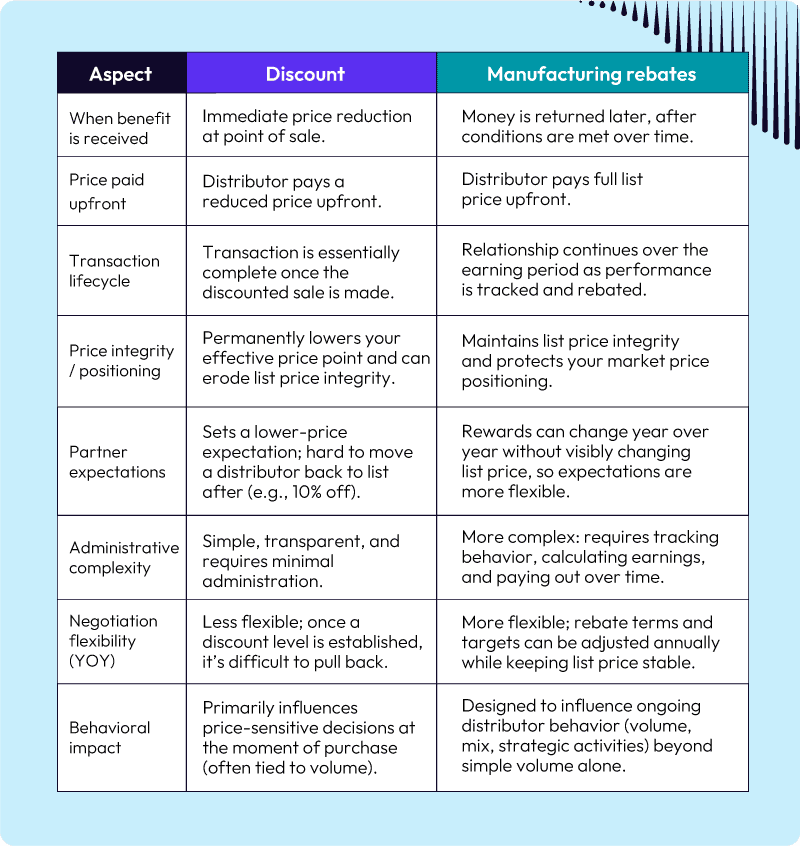
A discount is an immediate price reduction applied at the point of sale. The distributor pays less upfront, and the transaction is complete. Discounts are simple, transparent, and require minimal administration — but they also permanently lower your price point and set expectations that can be difficult to reverse. Once a distributor receives a 10% discount, asking them to return to list price becomes nearly impossible.
Manufacturing rebates, by contrast, maintain list price integrity while still rewarding performance. The distributor pays full price initially, then earns money back based on actual behavior over time. This structure offers several advantages: It protects your price positioning in the market, provides flexibility in year-over-year negotiations, and creates opportunities to influence distributor behavior beyond simple volume.
Where discounts make sense
Discounts work well in specific situations, such as:
- Simple, transactional deals where relationship depth isn’t a priority
- Clearing distressed inventory or end-of-life products
- Short-term promotional campaigns with defined start and end dates
- Situations where administrative simplicity outweighs strategic considerations
For example, a manufacturer clearing out an obsolete product line might offer a straightforward 20% discount to move inventory quickly. The goal is immediate sales, not long-term behavior change, making a discount the appropriate tool.
Where manufacturing rebates are better
Rebates excel when manufacturers need to drive sustained behavior change and build deeper partnerships. They’re ideal for:
- Encouraging long-term growth
- Shifting product mix toward strategic offerings
- Supporting joint business planning with key distributors
- Creating differentiated programs for different distributor segments without fragmenting your price list
The financial and behavioral advantages of rebates in manufacturing are significant. Rebates protect margins by ensuring distributors earn discounts only on actual performance, not promises. They enable manufacturers to target specific behaviors over extended periods — quarterly or annual programs create sustained focus rather than one-time transactions. Perhaps most importantly, rebates generate richer channel data for planning and forecasting, as manufacturers gain visibility into distributor purchasing patterns, growth trajectories, and product preferences.
What distributors actually want from manufacturing rebates
The most elegantly designed rebate program means nothing if distributors don’t engage with it. Understanding distributor pain points is the first step toward building programs they’ll actively pursue.
Distributors consistently cite several frustrations with manufacturing rebate programs:
- Confusing terms that require legal interpretation to understand
- Opaque earnings tracking that leaves them guessing whether they’re on track
- Late or inaccurate payments that erode trust
- Heavy administrative burden when programs are tracked manually across multiple spreadsheets
These pain points translate into clear design requirements: Distributors want clear, realistic targets tied to how they actually buy and resell — not arbitrary thresholds disconnected from market realities. They need simple, predictable earning mechanics they can explain to their sales teams in minutes, not hours. Real-time or near-real-time visibility into “how much have we earned?” is essential for maintaining engagement, and they must have confidence that payments will be accurate and arrive on time, every time.
It’s worth remembering that your manufacturing rebate program competes for attention with dozens of other supplier programs. If distributors cannot understand your rules in minutes, they simply won’t prioritize your goals. Complexity is the enemy of engagement.
Structuring manufacturing rebates that drive distributor behavior
Building an effective rebate program requires a systematic approach that aligns manufacturer objectives with distributor economics and sales motions.
1. Start with clear objectives
Before designing any rebate structure, define what you’re trying to achieve. Are you looking to increase share of wallet with existing distributors? Grow a specific product line that’s underperforming? Enter a new geography where you lack presence? Shift distributors toward higher-margin SKUs?
Each objective maps to a specific rebate structure. If you want to increase overall volume, a tiered volume rebate makes sense. If you’re launching a new product line, a product-mix bonus that rewards distributors for dedicating shelf space to the new offering is more appropriate. If you’re trying to grow in a new region, a market-development fund that reimburses local marketing expenses might be the right tool.
The key is specificity. “Increase sales” is too vague. “Grow Q4 sales of our premium product line by 20% among mid-tier distributors in the Southeast region” gives you a clear target to design around.
2. Align with distributor economics and sales motions
The best rebate programs acknowledge how distributors actually operate. Many distributors have parent-child structures, with national headquarters and multiple regional branches. A rebate program that sets separate targets for each branch might seem fair, but it creates administrative complexity and may exclude smaller branches that can’t hit individual thresholds.
Aggregating volume across all branches under a single parent company often works better. This approach recognizes the distributor’s organizational reality, simplifies tracking, and creates a larger pool of purchases that’s more likely to hit meaningful thresholds. A distributor with ten branches, each purchasing 1,000 units, might never trigger a 5,000-unit threshold if measured separately, but collectively they’d easily qualify.
Similarly, consider the time horizons that make sense for your industry. Quarterly rebate periods work well for products with shorter sales cycles and faster inventory turns. Annual programs suit industries with longer planning cycles and larger capital purchases. The goal is to match your rebate cadence to the natural rhythm of distributor purchasing.
3. Keep mechanics simple enough to sell internally
Complexity kills engagement. A rebate program with seven tiers, 15 product exclusions, and three different calculation methods might seem sophisticated, but it’s nearly impossible for a distributor’s sales team to understand and act on.
Aim for simplicity: a small number of tiers (three to four maximum), clear thresholds that are easy to remember and track, and minimal exclusions that don’t require constant reference to the fine print. The simpler your program, the more likely distributors will incorporate it into their sales planning and actively work toward your targets.
Remember that overly complex programs increase margin risk when managed in spreadsheets or ERP systems not built for rebates. Calculation errors, missed accruals, and disputes become more common as complexity rises, eroding the trust that makes rebate programs effective.
Where most manufacturing rebates go wrong
Even well-intentioned rebate programs can fail if they fall into common traps.
Structural mistakes
The most frequent structural errors include:
- Unrealistic targets based on historical run rates: For instance, setting a 50% growth requirement when the distributor has averaged 10% growth creates immediate disengagement.
- “All or nothing” thresholds: This is where distributors earn zero if they hit 99% of the target, but the full rebate at 100%. This type of structure can create frustration and perceived unfairness.
- Conflicting incentives: Conflicting incentives across overlapping programs confuse distributors about which goals to prioritize.
- Lack of clear communication: Poor communication about program rules, timelines, and payment schedules leaves distributors guessing.
Operational pitfalls
Beyond structural issues, operational challenges undermine even well-designed programs:
- Manual claim validation: These manual processes can take weeks or months to complete and erode trust.
- Data inconsistency: Inconsistent data from multiple systems, like ERPs, CRMs, and spreadsheets, creates disputes about what was actually purchased.
- Poor rebate management: Missed accruals where manufacturers fail to properly account for rebate liabilities lead to budget surprises and payment delays.
- Disputes: Disagreements between manufacturers and distributors can drag on for months, damage relationships, and make distributors question whether the rebate is worth the hassle.
These issues directly impact adoption. When sales teams stop talking about rebate programs because they’re too complex or unreliable, distributors stop planning against them. Finance teams begin treating rebates as a painful cost center rather than a strategic growth investment. And the entire program becomes a source of friction rather than alignment.
Role of rebates management software and tools
The complexity of modern manufacturing rebate programs has outpaced the capabilities of spreadsheets and general-purpose ERP systems. Rebates management software has emerged as a critical tool for manufacturers who want to run programs at scale without drowning in administrative burden.
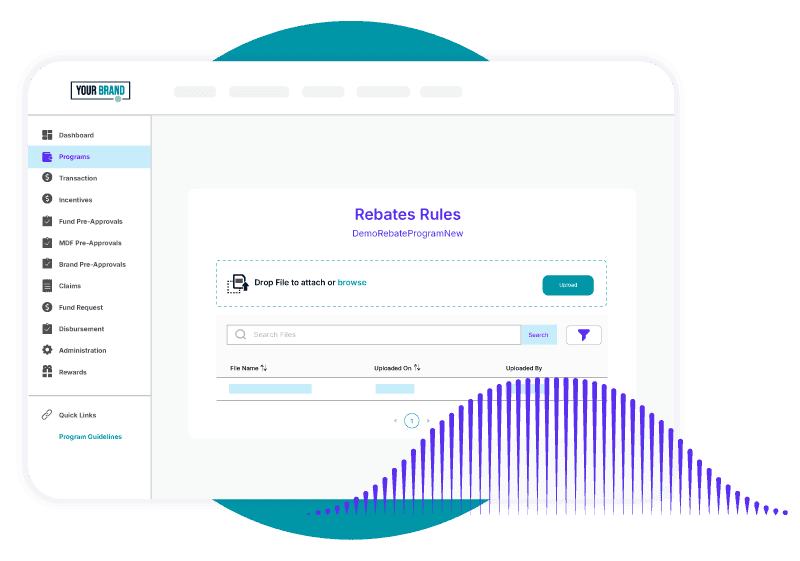
A rebate management tool is a specialized platform that centralizes rebate agreements, automates calculations based on actual transaction data, and provides real-time visibility into earnings and liabilities for both manufacturers and distributors. These systems integrate with existing ERP and CRM platforms to pull purchase data automatically, eliminating manual data entry and reducing errors.
Key capabilities manufacturers should look for
When evaluating rebates management software, manufacturers should prioritize several core capabilities:
- Central contract repository and standardized templates ensure all rebate agreements live in one place, with consistent structures that make it easy to create new programs and compare performance across distributors.
- Automated accruals based on actual transaction data eliminate manual calculations and ensure rebate liabilities are accurately reflected in financial statements. As distributors make purchases, the system automatically calculates earned rebates and updates accruals in real time.
- Self-service dashboards for distributors and internal sales teams provide transparency into program performance. Distributors can log in anytime to see exactly how much they’ve earned, how close they are to the next tier, and when payments are scheduled. Sales teams can use the same data to coach distributors toward higher performance.
- Audit trails, dispute management, and integration with ERP/CRM ensure compliance and make it easy to resolve questions about calculations or payments. When a distributor questions a rebate amount, manufacturers can pull detailed transaction histories showing exactly how the rebate was calculated.
The connection between software and distributor adoption is direct. When partners can see their performance against targets in real time, they’re far more likely to engage with manufacturing rebates as part of their sales planning. Transparency builds trust, and trust drives behavior change.
Turning manufacturing rebates into a data and planning advantage
Beyond their immediate impact on distributor behavior, well-managed rebate programs generate valuable data that can inform broader business strategy.
Clean rebate data reveals which distributors are growing, which are stagnating, and which product lines are gaining traction in different markets. This information can:
- Guide pricing strategy: If rebates are consistently maxed out in a particular region, it might signal an opportunity to raise list prices.
- Inform product strategy: The data can show which SKUs distributors are willing to push and which languish despite incentives.
- Enable joint business planning with distributors: Both parties can use shared data to set realistic targets and align on growth strategies.
- Enable distributor segmentation: Manufacturers can identify top performers who consistently hit targets and deserve enhanced programs, under-engaged accounts who might respond to different incentive structures, and high-potential partners who are growing quickly but haven’t yet reached top-tier status.
Some manufacturers are beginning to think of rebates as “growth capital” for distributors — programs that fund inventory expansion, marketing investments, or geographic growth when structured and forecasted correctly. This mindset shift transforms rebates from a cost of doing business into a strategic investment in channel development.
Implementation checklist: building programs distributors actually use
Turning theory into practice requires a systematic approach. Use this checklist to guide your rebate program development:
![Rebate Program Implementation Checklist
Strategy and design
[ ] Define clear, prioritized objectives for each rebate program
[ ] Map specific rebate structures to each objective
[ ] Ensure targets are realistic based on historical performance data
[ ] Limit complexity — aim for 3-4 tiers maximum with minimal exclusions
Distributor alignment
[ ] Validate targets and program mechanics with a sample of distributor partners before rollout
[ ] Gather feedback from account managers who work directly with distributors
[ ] Test program communication materials with actual distributors to ensure clarity
[ ] Adjust based on feedback before full launch
Technology and data
[ ] Confirm you have a rebates management software or rebate management tool that can handle your program complexity
[ ] Ensure the system integrates with your ERP and CRM for automated data flow
[ ] Verify that distributors will have self-service access to performance dashboards
[ ] Test calculations thoroughly before going live
Communication and enablement
[ ] Create a one-page summary for each rebate program with clear rules and examples
[ ] Develop "what's in it for you" messaging tailored to different distributor segments
[ ] Train your sales team on program mechanics and how to coach distributors
[ ] Provide distributors with tools to track their own performance
Governance and optimization
[ ] Set a quarterly cadence to review program performance and distributor feedback
[ ] Track key metrics: participation rate, average rebate per distributor, disputes, payment timeliness
[ ] Identify underperforming programs and diagnose root causes
[ ] Iterate on program design at least annually based on performance data](https://ansira.com/wp-content/uploads/2026/01/Rebate-Program-Checklist-1.png)
FAQ: common questions about manufacturing rebates
How do manufacturing rebates work with multiple distributors and branches?
Most manufacturers aggregate purchases across all branches under a single parent company to simplify tracking and increase the likelihood of hitting thresholds. This approach recognizes organizational realities and reduces administrative burden for both parties.
How do manufacturing rebates impact pricing, margins, and reporting?
Rebates reduce net realized price but maintain list price integrity. From an accounting perspective, rebates are typically accrued as liabilities as purchases occur, then paid out at the end of the rebate period. Proper accrual accounting ensures rebate costs are matched to the periods when sales occur.
When should a manufacturer use a rebate vs. a discount?
Use rebates when you want to drive sustained behavior change, protect price positioning, and reward actual performance rather than promises. Use discounts for simple transactions, clearing distressed inventory, or short-term promotions where administrative simplicity is paramount.
Do small and mid-sized manufacturers really need rebates management software?
If you’re running more than a handful of rebate programs or working with more than a dozen distributors, spreadsheets quickly become unmanageable. The cost of errors, disputes, and administrative time typically exceeds the investment in purpose-built, rebate management software within the first year.
How long should a typical manufacturing rebate program run?
Most programs operate on quarterly or annual cycles. Quarterly programs work well for products with shorter sales cycles and faster inventory turns. Annual programs suit industries with longer planning horizons and larger capital purchases. The key is matching your rebate cadence to the natural rhythm of distributor purchasing.
Make your rebate program work harder for you
The most effective manufacturing rebates aren’t the most complex — they’re the ones distributors can understand, track, and trust, and that manufacturers can manage confidently at scale. Simplicity, transparency, and alignment with distributor economics matter more than sophisticated tier structures or elaborate calculation formulas.
As you evaluate your current programs, ask yourself: Can my distributors explain our rebate program to their sales teams in under five minutes? Do they have real-time visibility into their earnings? Are payments consistently accurate and on time? If the answer to any of these questions is no, you have an opportunity to improve.
It’s time to partner with experts who specialize in modernizing manufacturing rebate strategies. The right combination of program design, technology infrastructure, and ongoing optimization can transform rebates from an administrative burden into a powerful engine for channel growth.
Ansira helps manufacturers do exactly that — combining rebate strategy, fund management, and partner marketing into a single, scalable platform built for distributed ecosystems. If you’re ready to turn your rebate program into a growth engine your distributors actually use, get in touch with our team to see how Ansira Incent and our channel experts can support your next step.