
If you work through channel partners, you already know that incentives are both powerful and complicated. Between marketing development funds (MDFs), rebates, co‑op, sales promotions, sales performance incentive funds (SPIFs), tier benefits, and more, you’re juggling a lot of levers — each with its own rules, timelines, and stakeholders. It’s no wonder partners can feel confused about what to prioritize, and internal teams struggle to connect spend to outcomes.
This is where going back to basics can make a big impact. When you have a clear answer to what incentives are in your channel, how MDFs actually work, and where sales promotion tactics fit into your broader strategy, it becomes much easier to design programs partners actually use and your business can actually measure.
In this article, we’ll walk through the foundations of channel incentives, including:
- A channel‑centric definition of incentives
- How MDFs work and how they differ from co‑op funds
- A practical definition for sales promotion with channel examples
- How MDFs, sales promotions, and other incentives fit together in an incentive stack
- A simple framework with quick wins to strengthen your channel incentive foundation
What are incentives in channel marketing?
It’s hard to optimize incentives if you don’t have a shared, working definition. In channel marketing, what are incentives really?
In simple terms, channel incentives are structured rewards or benefits you offer to partners and end-customers to drive specific, measurable behaviors. Those behaviors can include:
- Sell‑in: Getting partners to stock, list, or bundle your solutions
- Sell‑through: Driving end‑customer demand and closing deals faster
- Retention and loyalty: Keeping your products front and center over competitors
- Capability building: Certifications, solution specialization, and enablement activities
- Data sharing: Reporting point of sale (POS) data, deal registration, pipeline visibility, or marketing performance
Put another way, when you ask, “What are incentives?” you’re really asking: What behaviors do we need from our ecosystem, and what value are we willing to exchange for those behaviors?
Partner‑facing vs. customer‑facing incentives
Most channel programs blend two broad categories of incentives:
1. Partner‑facing incentives
These are rewards you offer directly to distributors, resellers, agents, and other intermediaries. Common examples include:
- Marketing development funds (MDFs)
- Rebates based on volume, growth, or mix
- SPIFs and seller bonuses tied to specific SKUs or behaviors
- Volume bonuses and tiered benefits (better margins, market development support, or access to leads at higher tiers)
Partner‑facing incentives are usually designed to shape how partners prioritize, position, and resource your brand.
2. Customer‑facing incentives and promotions
These are offers that touch the end-customer directly, even if they’re executed through partners. Examples include:
- Consumer or B2B discounts and coupons
- End‑user rebates funded by you, the vendor
- Bundles and value‑added offers (e.g., free services with purchase)
- Limited‑time sales promotions on specific products or solutions
Customer‑facing incentives are designed to stimulate demand, improve conversion, or accelerate decision cycles in the market.
Both layers are important. The most effective channel incentive programs align what you’re asking partners to do with what you’re offering customers, so promotions feel coherent, not conflicting.
Part of a broader incentive stack
Channel incentives rarely exist in isolation. They sit inside a broader incentive stack that can also include:
- Marketing incentives: Like MDF, co‑op funds, and joint campaign investments
- Sales incentive programs: Like seller SPIFs, accelerators, and performance bonuses
- Program benefits: Such as access to leads, dedicated support, or co‑branded assets
Understanding where each incentive fits in that stack is critical for designing programs that are both partner‑friendly and performance‑driven.
What is MDF and how does it work?
Ask any channel leader where a big chunk of their budget sits, and MDF is likely near the top of the list. But despite their importance, many programs still struggle to fully utilize MDF and link it clearly to revenue.
At a basic level, marketing development funds are vendor‑funded budgets that approved partners can use for eligible marketing and demand generation activities. These funds are intended to:
- Help partners generate demand for your solutions in their local markets
- Support joint marketing plans and co‑branded campaigns
- Enable partners to invest in events, digital programs, and enablement they might not otherwise prioritize
When partners ask for MDF, they’re asking you to co‑invest in activities that should benefit both of you — but the details of how that works can vary dramatically from program to program.
MDF vs. co‑op funds: key differences
MDF is often confused with co‑op funds, but they usually operate quite differently. In modern channel incentive programs, many brands operate both MDF and co‑op side by side, but the intent and mechanics are not the same.
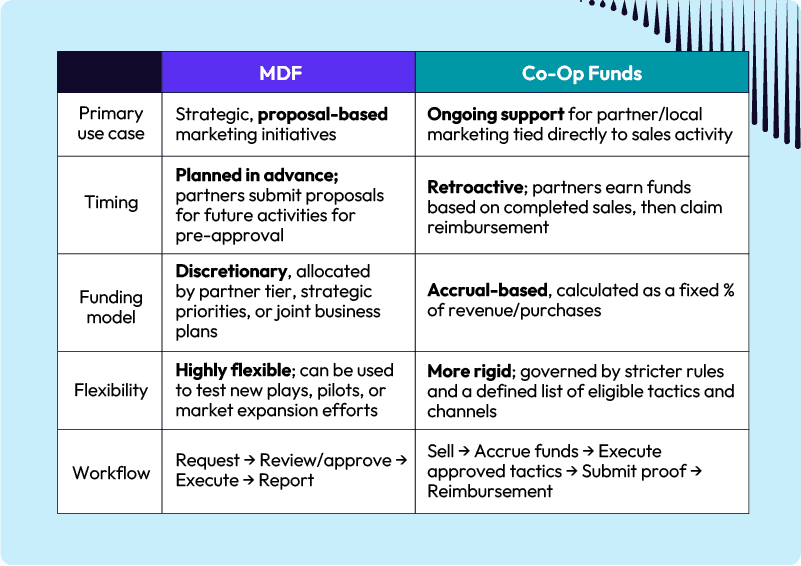
Timing and planning
MDF is typically planned and proposal‑based. Partners request funds for future activities that you review and approve in advance.
Co‑op funds are often retroactive, where partners earn funds as a percentage of completed sales and then claim reimbursement for approved marketing expenses.
Funding model
MDF may be discretionary — allocated based on partner tier, strategic focus, or joint business planning.
Co‑op funds are more likely to be accrual‑based, calculated as a set percentage of revenue or purchases (e.g., 2 percent of last quarter’s sales).
Flexibility
MDF can be highly flexible and strategic, used to test new plays or support market expansion.
Co‑op funds are often governed by stricter, pre‑defined rules and a narrower set of approved tactics.
Typical MDF characteristics
While MDF details vary by industry and partner type, most programs share a few common elements:
Funding models
MDFs may be allocated using:
- A percentage of revenue or bookings over a specific period
- Tiered benefits, where Gold or Platinum partners receive larger or more flexible budgets
- Strategic pools, where HQ or regional teams hold funds and allocate them for launch campaigns, growth markets, or priority partners
Eligible activities
MDFs can typically fund a wide range of marketing and enablement initiatives, such as:
- Integrated campaigns and always‑on digital advertising
- Webinars, workshops, and in‑person events
- Content syndication and lead‑generation programs
- Partner microsites, landing pages, and nurture journeys
- Sales enablement assets or local adaptations of corporate content
Approval and claim process
A standard MDF process usually includes:
- Plan or proposal submission by the partner
- Review and approval by the vendor or a channel agency
- Execution of the campaign or activity
- Proof of performance and claims — often including invoices, screenshots, attendee lists, and performance metrics
- Reimbursement or funds draw‑down once claims are approved
On paper, this is straightforward. In practice, it can be time‑consuming and frustrating if it relies on spreadsheets, email back‑and‑forth, and inconsistent documentation requirements.
Common MDF challenges
Even well‑designed MDF programs run into familiar obstacles:
- Low utilization due to process friction: Partners may leave money on the table because forms are confusing, approval steps are unclear, or they don’t have dedicated marketing resources. If claiming funds feels harder than running a basic promotion, they’ll default to self‑funded, “easy” tactics.
- Over‑reliance on the same old tactics: Without guidance, partners default to what they know — trade shows, one‑off email blasts, or generic social posts. That can limit return on investment compared to data‑driven campaigns like targeted digital media, account‑based marketing, or nurture programs.
- Limited visibility into performance: Many brands struggle to connect MDF spend to actual pipeline and revenue. Reporting may be limited to “funds requested vs. claimed,” with little insight into which partners and activities are moving the needle.
These challenges don’t mean MDF programs are broken. They mean your channel incentive foundations need clearer rules, better enablement, and modern tools — especially as you connect MDFs to broader marketing incentives and sales incentive programs.
What is a sales promotion? (definition and channel examples)
MDF and rebates tend to operate on longer time horizons. Sales promotions are different. They’re the short, sharp tools you use to create demand spikes and focus attention on specific products, segments, or time periods.
So, what is sales promotion in a channel context?
A practical definition for sales promotion is short‑term, tactical incentives designed to stimulate immediate demand or accelerate purchases from customers or intermediaries.
When people talk about promotion and sales promotion, they’re usually referring to limited‑time offers that give buyers or sellers an extra reason to act now instead of later.
Types of consumer‑facing sales promotions
On the customer side, common sales promotions include:
- Coupons and discount codes: Digital or physical offers that reduce price for a limited time
- Rebates: End‑user rebates funded by the vendor, often processed post‑purchase
- Limited‑time discounts: Price reductions tied to a launch window, quarter‑end, or seasonal event
- Bundles and value‑adds: Package deals that combine products or services at an attractive combined price
In a channel, these promotions are frequently executed through partners but funded or co‑funded by the vendor.
Types of partner‑facing sales promotions
Not all promotions show up on the customer invoice. Many sales promotions are aimed at the partner organization or their sales teams, for example:
- Short‑term bonuses on specific SKUs: Higher margins or rebates for selling featured products during a defined promo window
- Limited‑time margin enhancements: Extra percentage points of margin for deals that meet certain criteria (e.g., new logo, cross‑sell, or strategic vertical)
- Sell‑through incentives: Payments based on POS data or proof that inventory is moving, not just purchased
These partner‑facing promotions sit alongside other sales incentive programs like SPIFs or accelerators, but they are time‑bound and tactical by design.
How sales promotions differ from structural incentives
Compared to MDFs, ongoing rebates, or standard discounts, sales promotions are typically:
- Shorter‑term: They run for days, weeks, or a quarter — not an entire fiscal year. The goal is a defined spike in activity.
- More tactical: They target specific SKUs, solution bundles, customer segments, or geographies. They’re often tied to events like quarter‑end pushes, new product launches, competitive displacement plays, and inventory clear‑outs.
- More urgent and visible: By design, promotions make it obvious that “now is the time” for partners or customers to act. They rely on clear messaging, simple rules, and strong communication.
Well‑designed promotion and sales promotion tactics complement, rather than compete with, your longer‑term channel incentives such as MDFs and rebates.
MDF vs. sales promotions vs. other incentives: How they fit together
Individually, MDF, rebates, and sales promotions all make sense. The real challenge is aligning them so partners aren’t buried in disconnected offers and your team isn’t funding activity that cancels itself out.
One helpful way to think about this is as an incentive stack for your channel program.
A simple incentive stack for channel programs
You can group most incentives into three layers:
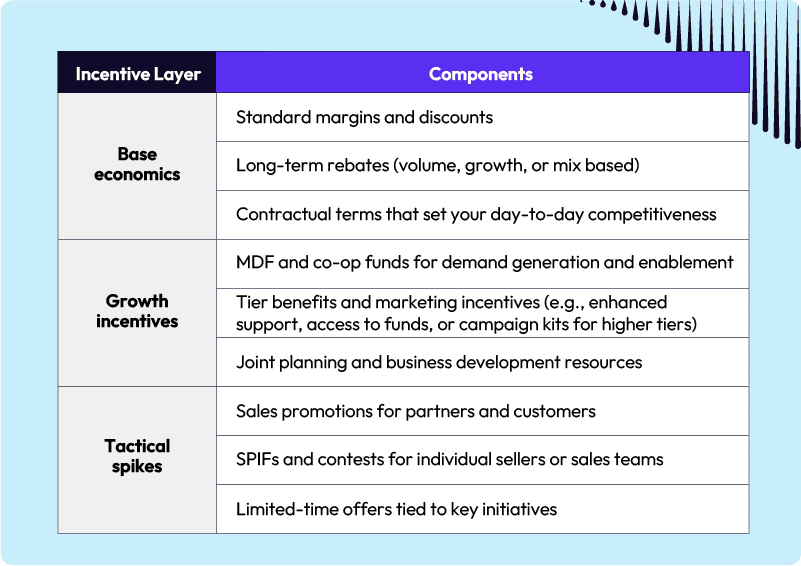
When this stack is designed intentionally, each layer reinforces the others.
Roles of MDFs, sales promotions, and other incentives
Within the stack, each incentive has a different purpose:
- MDF: Supports planned, co‑created marketing with partners. They’re about building pipeline and market presence over time, not just closing this week’s gap.
- Sales promotions: Create short‑term demand spikes or focus attention on specific SKUs, customer segments, or time windows. They’re your “surge” capability.
- Other incentives: This includes SPIFs, rebates, and tier benefits — keep the overall relationship economically competitive and reward sustained performance, not just one‑off wins.
Together, they form a toolkit you can deploy to support your channel strategy instead of a random assortment of unconnected offers.
Avoiding misalignment and confusion
Without a clear design, incentive stacks quickly become noisy and counterproductive. Common pitfalls include:
- Too many overlapping promotions: Partners may face multiple, conflicting sales promotions on overlapping SKUs or timeframes. That creates confusion and makes it hard for them to prioritize.
- MDF funding the wrong activities: If MDFs are used for disconnected activities that don’t support your growth goals or your current promotions, you end up with spend that feels busy but not effective.
- Partners are unsure what to prioritize: When every email announces a “can’t‑miss offer,” none of them stand out. Partners default to what’s easiest instead of what’s most valuable.
A clear, documented incentive stack — plus aligned messaging and governance — helps your partners see how MDF, promotions, and other channel incentives work together, not against each other.
A simple framework to design a foundational channel incentive program
If your incentives feel more like a patchwork than a strategy, it may be time to revisit your channel incentive foundations. The good news is you don’t have to start from scratch. You can use a straightforward framework to organize what you already have and design what comes next.
1. Clarify the partner behaviors you need
Start by identifying the behaviors you need from partners and their sellers, such as:
- Onboarding and activating new logo accounts
- Upselling or cross‑selling specific solutions or bundles
- Driving co‑funded campaigns into target verticals or regions
- Investing in training and certifications to sell higher‑value solutions
- Providing data and visibility (deal registration, POS reporting, marketing performance)
Be as specific as possible. The more precise your behavioral goals, the easier it is to design effective channel incentives and sales incentive programs.
2. Map incentives to the right behaviors
Next, map your incentive tools to the behaviors you need to drive. When you pair each desired behavior with the right incentive mechanism, your programs become easier to explain internally and externally.
MDF → co‑marketing motions
Use MDF to encourage behaviors like joint planning, execution of approved campaigns, and investment in digital demand generation. For example:
- Fund a campaign kit partners can customize and run in their market.
- Support events tied to launch priorities or vertical plays.
Sales promotions → short‑term volume and focus
Use sales promotions to create urgency around:
- Quarter‑end pushes or fiscal year milestones
- Inventory clear‑outs or ramp‑up of new SKUs
- Targeted vertical wins where you need quick case studies
Rebates and SPIFs → sustained performance and specific actions
Use ongoing rebates and SPIFs to reward:
- Hitting annual or semiannual volume and growth targets
- Maintaining a healthy product mix or solution attach rate
- Achieving and maintaining certifications or specialization levels
3. Standardize rules and governance
Strong channel incentive foundations depend on clear, consistent rules. That means:
- Eligibility criteria: Which partners, products, and customer segments qualify for which incentives
- Proof of performance requirements: What documentation is required for MDF claims, promotional payouts, or rebates
- Approval workflows: Who reviews MDF proposals, who owns promotion setup, and how exceptions are handled
- Compliance guardrails: Ensuring promotions and incentives adhere to legal, regulatory, and brand standards across regions
Standardizing governance doesn’t mean every incentive is identical. It means they operate within a common framework, making them easier to administer and easier for partners to understand.
4. Develop measurement and visibility
To optimize your channel incentive programs, you need visibility into:
- Spend vs. budget: By incentive type, partner, region, and product
- Pipeline and revenue impact: Tying MDF and sales promotions to actual performance, not just activity volume
- Partner engagement: Which partners consistently use funds and participate in promotions, and which are under‑engaged
- Offer effectiveness: Which incentives drive the highest return, and which might be retired or redesigned
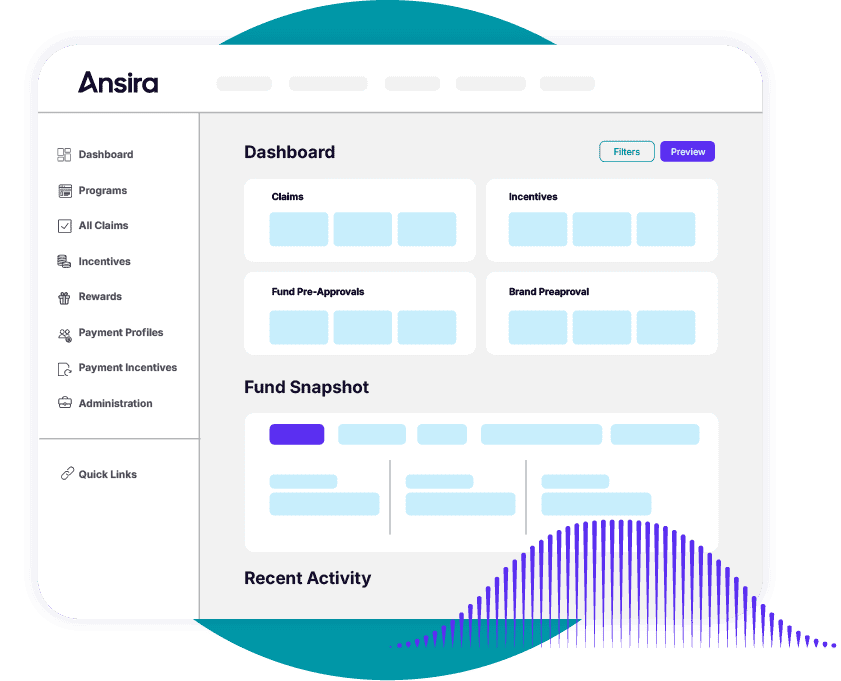
This typically requires integrated dashboards that connect MDF and promotion data to CRM, sales, and marketing performance systems. The goal is not just tracking, but learning — so you can refine over time.
5. Iterate based on partner feedback and performance
Finally, treat your incentive design like any other strategic program: test, learn, and iterate.
- Gather partner feedback on what’s working, what’s confusing, and where friction exists.
- Use performance data to refine funding models, promo mechanics, and communication.
- Gradually introduce more sophisticated marketing incentives like tier bonuses, data‑sharing rewards, or joint account‑based programs once the basics are working smoothly.
With a strong foundation in place, it becomes far easier to scale channel incentive programs without overwhelming partners or internal teams.
Getting started: Quick wins to clean up your MDF and sales promotions
Strengthening your channel incentive foundations doesn’t have to mean a multi‑year transformation. There are actionable steps you can take this quarter to improve how MDF and sales promotions work for your business and your partners.
Here are a few “start tomorrow” ideas:
- Audit current MDF and promotion usage
- Identify where funds are consistently under‑utilized or left unclaimed.
- Look for misalignment between where you’re spending (products, segments, partners) and where your strategy says growth should come from.
- Simplify 1-2 high‑friction processes
- Streamline your MDF claim forms — remove redundant fields and clarify required documentation.
- Standardize how you announce and explain sales promotions by using a consistent template that spells out eligibility, timelines, and rewards in plain language.
- Consolidate incentive messaging for partners
- Move from scattered emails and PDFs to a single, clear view of active incentives and promotions, ideally in a partner portal or regularly updated guide.
- Highlight how MDFs, promotions, and other incentives fit together so partners know what to prioritize today vs. plan for over the quarter.
- Pilot one data‑driven MDF play
- Choose a focused, measurable MDF initiative — for example, a digital campaign targeting a specific vertical or solution.
- Provide partners with pre‑built assets, clear KPIs, and simple reporting expectations to show the value of more modern, data‑driven tactics.
- Run one high‑impact sales promotion with clear metrics
- Design a time‑bound promotion tied to a concrete goal, such as driving pipeline for a new product, clearing inventory, or winning competitive replacements.
- Define success upfront (e.g., incremental revenue, new logos, or attach rate) and build measurement into the promotion mechanics from day one.
These quick wins help you prove the value of a more intentional approach to channel incentives, while building the case for further investment in tools, analytics, and partner experience.
A thoughtful approach to incentives, how MDFs function, and how sales promotion tactics fit into your broader channel strategy can transform incentives from a cost center into a competitive advantage. When your channel incentive programs are clear, aligned, and data‑driven, partners know exactly how to engage — and you can see exactly how that engagement drives growth.
Streamline your incentive programs with Ansira
Ansira helps manufacturers, distributors, and brands design and operate channel incentive programs that partners actually use. If you’re ready to modernize your MDF, streamline promotions, and build stronger channel incentive foundations, our team can help you turn complexity into clarity and performance.
Just like our work with Allied Air — we helped them achieve 1000% ROI on their marketing fund management program, thanks to Ansira Incent, and we can help you, too!
Talk to one of our experts to learn more.